Your Phone Camera Is Better Than You Think
People often tell me, "I need a better camera." Then they show me their phone photos, and the problem is rarely the phone. Modern phones combine decent sensors with astonishing software. Most disappointing photos come from a few habits. Fix those, and your phone starts behaving like a real camera.
1. Clean the lens
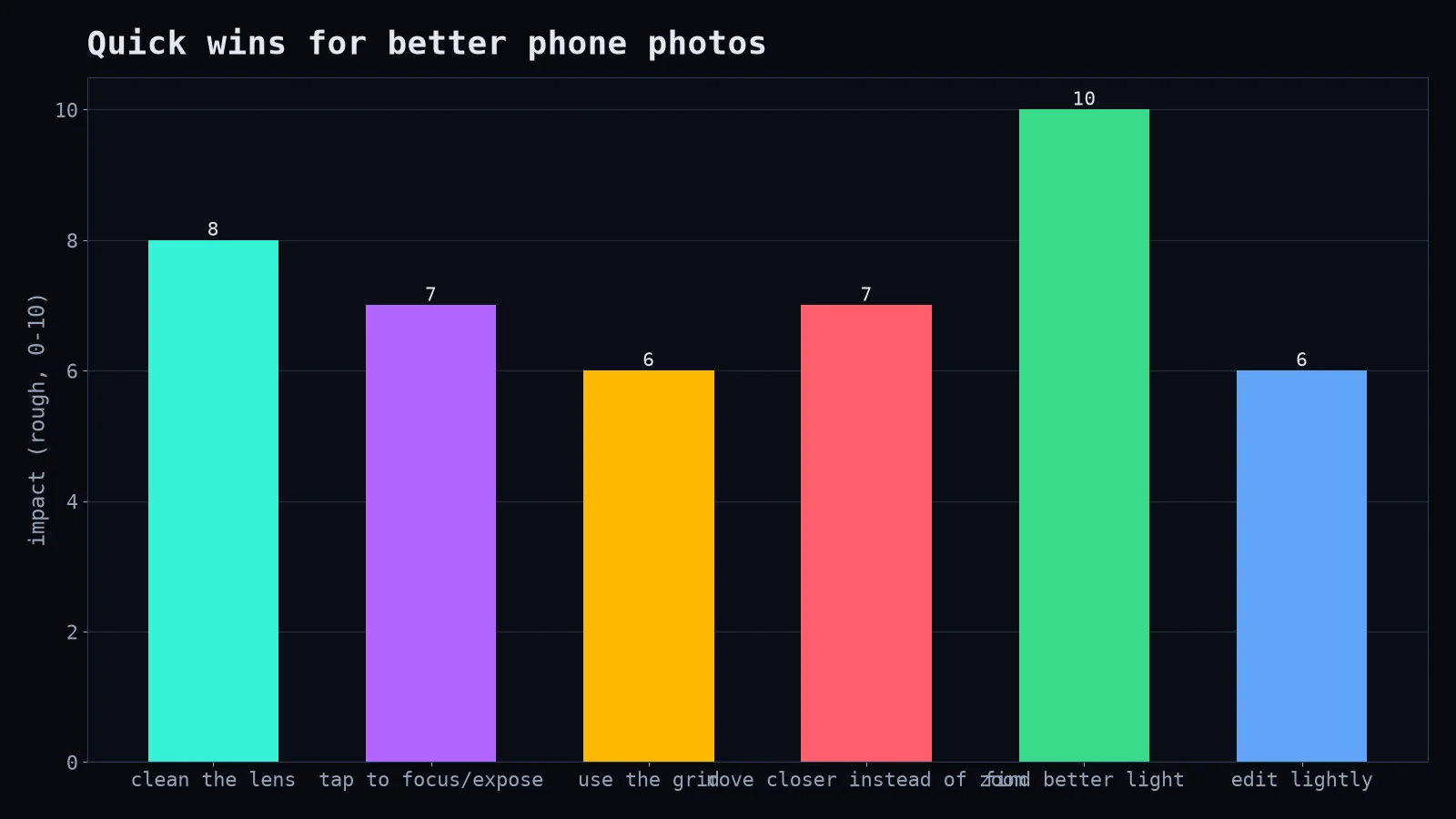
Your phone lives in pockets, hands and bags. The lens is almost always covered in fingerprint grease, which makes photos hazy and turns lights into smeary glows. Wipe it with a soft cloth (or your T-shirt, in an emergency) before shooting. This one habit fixes a remarkable number of "my camera is bad" complaints.
2. Tap to focus, then adjust brightness
Tap on your subject. The phone focuses there and sets exposure for it. Then, on most phones, you can slide up or down to make the photo brighter or darker before you shoot. For sunsets, slide down to keep the colours from washing out.
Long-press to lock focus and exposure, so the phone doesn't change its mind when you recompose.
3. Turn on the grid
The rule-of-thirds grid helps you level horizons and place subjects deliberately. Crooked horizons are the most common flaw in phone photos, and the easiest to avoid.
4. Move closer instead of pinching to zoom
Pinch-zoom on the main camera is often just cropping, which throws away detail. If your phone has a telephoto lens, use the dedicated zoom button (2x, 3x, 5x). Otherwise, walk closer. "Zoom with your feet" is old advice that's still right.
5. Look for light first
The same phone can produce a muddy photo in a dim restaurant and a stunning one by a window. Turn your subject toward the light. Sit by windows. Shoot outdoors in the early morning or late afternoon. Night modes are impressive, but good light is always better.
6. Hold still
In low light, phones take longer exposures or combine several frames. Brace your elbows against your body or a wall, and keep still for a moment after the shutter sound.
7. Shoot more, then choose
Burst mode or a few extra frames costs nothing. For people, take several shots; one will have open eyes and a natural expression.
8. Edit, but gently
Three adjustments cover most photos:
- Crop and straighten.
- Exposure/brightness and shadows (lift shadows a bit for backlit scenes).
- Warmth (slightly warmer for skin tones and sunsets).
Avoid cranking saturation and "clarity" to the maximum. Over-edited photos look great for about four seconds.
9. Learn your phone's modes
Portrait mode, night mode, macro and RAW or "pro" mode on many phones. Spend ten minutes with each. Most people never open half of what their camera can do.
The honest truth
Dedicated cameras still win at fast action, very low light and long telephoto shots. But the best camera is genuinely the one you have with you, and you have your phone with you all the time. Treat it as a real camera, and it'll start acting like one.