Reading Research Papers Efficiently: The Three-Pass Method
When I started my PhD, I read papers like novels: first page to last, every word, every equation. I read about two papers a week and remembered roughly none of them. Meanwhile, my reading list grew faster than I could read, like a sourdough starter that feeds on PDFs.
The fix was learning that papers aren't meant to be read in one way. A well-known approach, described in a short essay by S. Keshav, is to read in up to three passes.
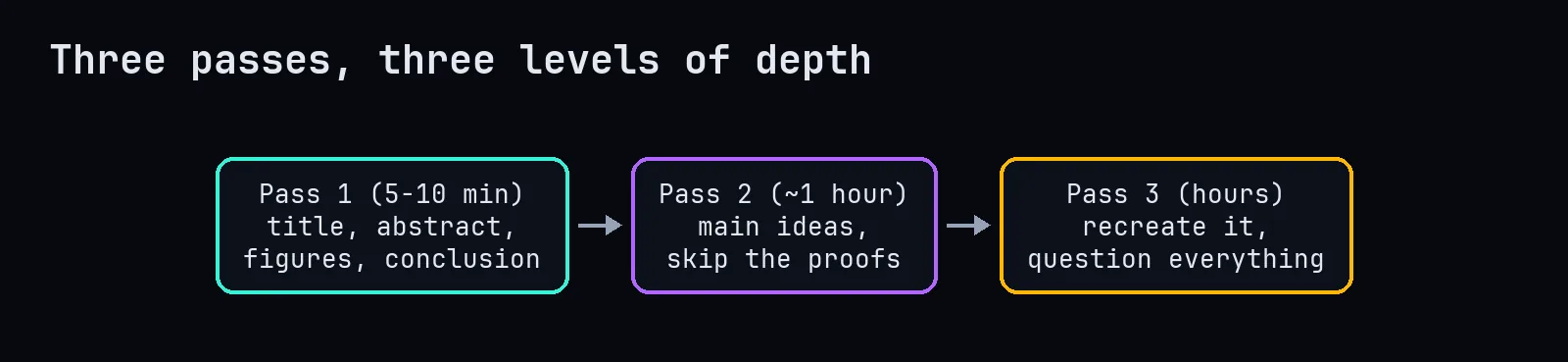
Pass 1: the bird's-eye view (5–10 minutes)
Read only:
- title and abstract
- introduction (quickly)
- section headings
- figures and tables, with their captions
- conclusion
Then answer five questions: What type of paper is this? Is it relevant to me? Is it based on valid assumptions? What are its main contributions? Is it clearly written?
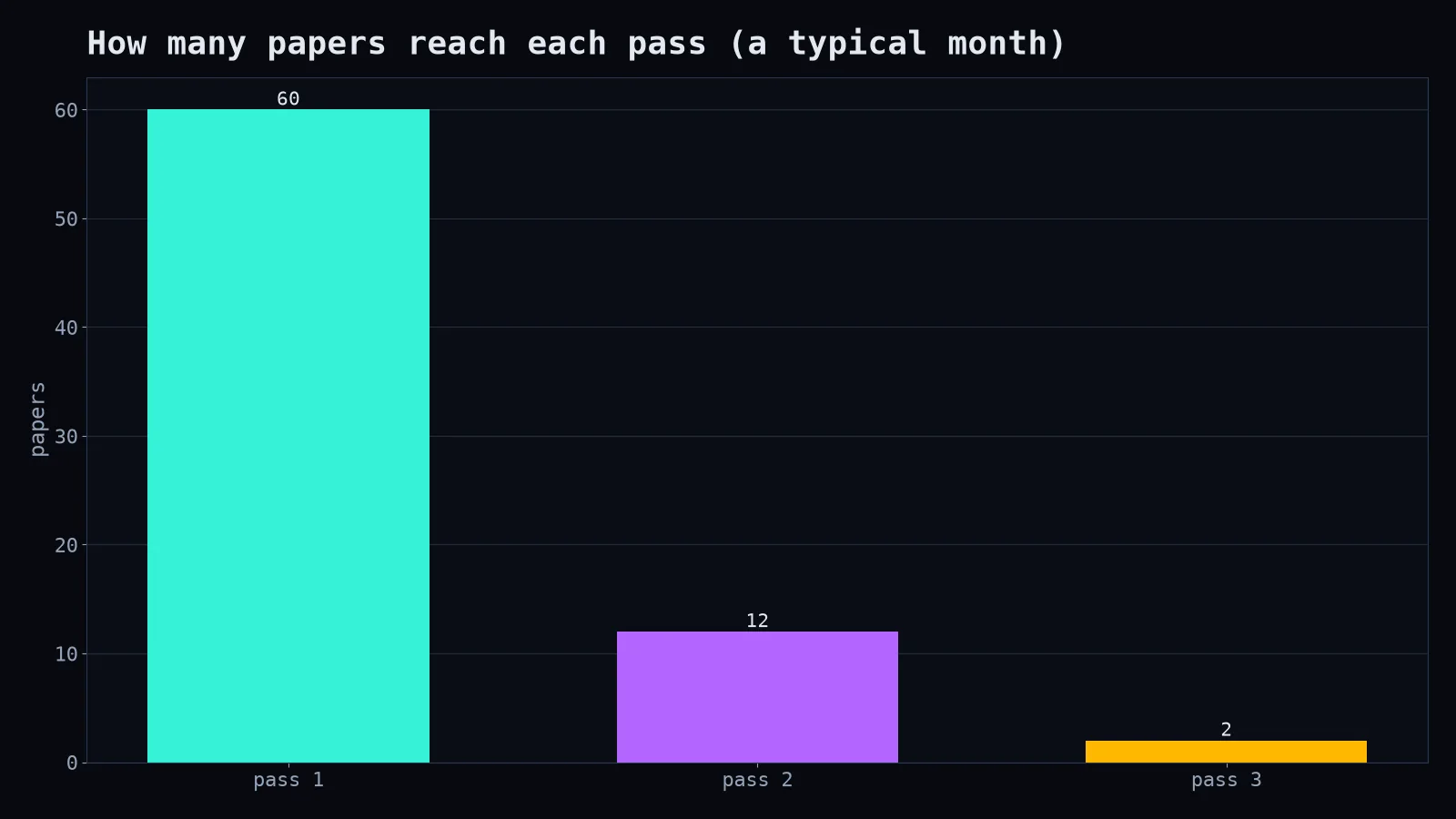
Most papers stop here. That's not lazy; it's triage.
Pass 2: understand the content (about an hour)
Read the whole paper more carefully, but skip dense proofs and details. Focus on:
- the problem and why it matters
- the method's key idea, in your own words
- the experimental setup: data, baselines, metrics
- the main results and whether the evidence supports the claims
Write down unfamiliar terms and references worth following. At the end, you should be able to explain the paper to a labmate in a few minutes.
Pass 3: virtually re-implement it (several hours)
For papers central to your own research. Try to recreate the work in your head, or literally in code. Challenge every assumption: would this still work with different data? What did they not test? Where are the weaknesses? This is where new research ideas come from.
A note template that works
## Paper: <title> (<authors>, <year>)
- One-sentence summary:
- Problem:
- Key idea:
- Data / experiments:
- Main result (with numbers):
- Limitations I noticed:
- Useful for my work because:
- Follow-up references:
Five minutes of notes after reading saves an hour of re-reading later. Store them where you can search them.
Other habits that help
- Read with a question. "How do others handle missing labels in satellite data?" makes skimming focused.
- Follow the citation trail both ways: backwards to foundational papers and forwards to newer papers that cite this one.
- Read surveys first in a new area. A good survey paper saves months.
- Discuss papers in a reading group. Explaining is the best test of understanding.
- Use AI tools carefully. They can help summarise or explain unfamiliar terms, but always verify claims against the paper itself.
The mindset
You'll never read everything. Nobody does. The goal isn't to read more papers; it's to understand the right papers well enough to build something new on top of them.