Salary Negotiation for People Who Hate Negotiating
Some people enjoy negotiating. They haggle at markets for fun and ask for discounts at hotels. I am not one of those people. My instinct when I receive a job offer is to say "thank you so much, yes!" before the recruiter has finished the sentence.
If you're like me, this guide is for you. It's built on preparation and scripts, not on becoming a different person.
Why it's worth the discomfort
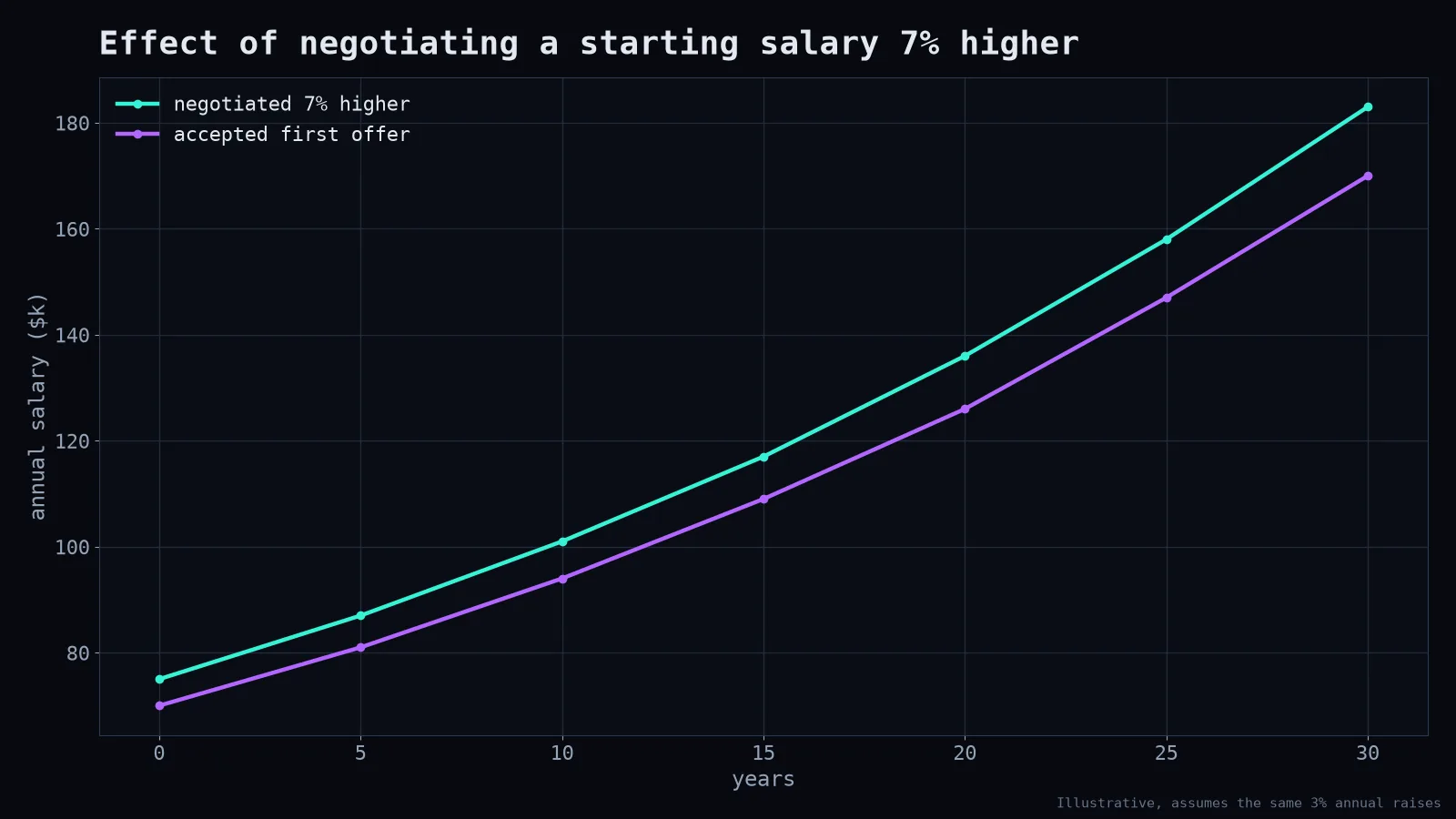
Raises are usually percentages of your current salary, and future employers often anchor on it too. A few thousand dollars more at the start can add up to a large sum over a career. Ten uncomfortable minutes can be the best-paid ten minutes of your year.
Step 1: Research your range
Use salary surveys, job postings that include pay ranges (increasingly required by law in some places), sites where people share salaries, and conversations with people in similar roles. Know three numbers:
- Your target: a good, realistic salary for this role and location.
- Your ask: a bit above your target, so there's room to meet in the middle.
- Your walk-away: below this, you'd rather keep looking.
Remember the whole package: base salary, bonus, equity, retirement contributions, vacation, remote flexibility, learning budget, signing bonus.
Step 2: Try not to name the first number
If asked about salary expectations early, you can deflect politely:
"I'm focused on finding the right fit first. I'm sure we can find a number that works if this is a match. What's the range budgeted for this role?"
If they insist, give a researched range whose bottom is a number you'd be happy with.
Step 3: When the offer arrives, don't accept on the spot
"Thank you, I'm really excited about this. Could I have a couple of days to review the full offer?"
This is normal and expected. Nobody withdraws an offer because you asked for 48 hours.
Step 4: Ask, calmly, with a reason
"I'm very excited to join. Based on my research for this role in Toronto and the experience I'd bring with X and Y, I was hoping for a base salary closer to $___. Is there flexibility there?"
Then stop talking. The silence will feel enormous. Let it be enormous. The next person to speak is usually the recruiter, often with "let me check with the team."
Step 5: If base salary is fixed, negotiate something else
Signing bonus, extra vacation days, an earlier salary review, a better title, a learning budget, remote days or relocation support. Many of these come from different budgets.
Things not to do
- Don't lie about competing offers.
- Don't make ultimatums you won't follow through on.
- Don't apologise for asking. You're having a normal business conversation.
- Don't negotiate after you've already said yes, unless something genuinely changed.
A note for immigrants and first-generation professionals
Many of us grew up in cultures where asking for more money from an employer feels rude or ungrateful. In many workplaces, especially in North America, a polite counter-offer is expected and respected. Recruiters often plan for it. Not negotiating doesn't make you look humble; it usually just makes you underpaid.
The worst realistic outcome
In most cases, the worst that happens is they say "this is the best we can do," and you decide whether to accept the original offer. That's it. The fear is much bigger than the risk. Write your script, practise it out loud and send that email.