Remote Work vs the Office: The Eternal Standup
Few workplace topics produce as much heat as this one. Remote advocates describe offices as fluorescent prisons with bad coffee. Office advocates describe remote workers as people answering Slack from the beach. Both are caricatures, and both sides have a point.
What remote work is genuinely good at
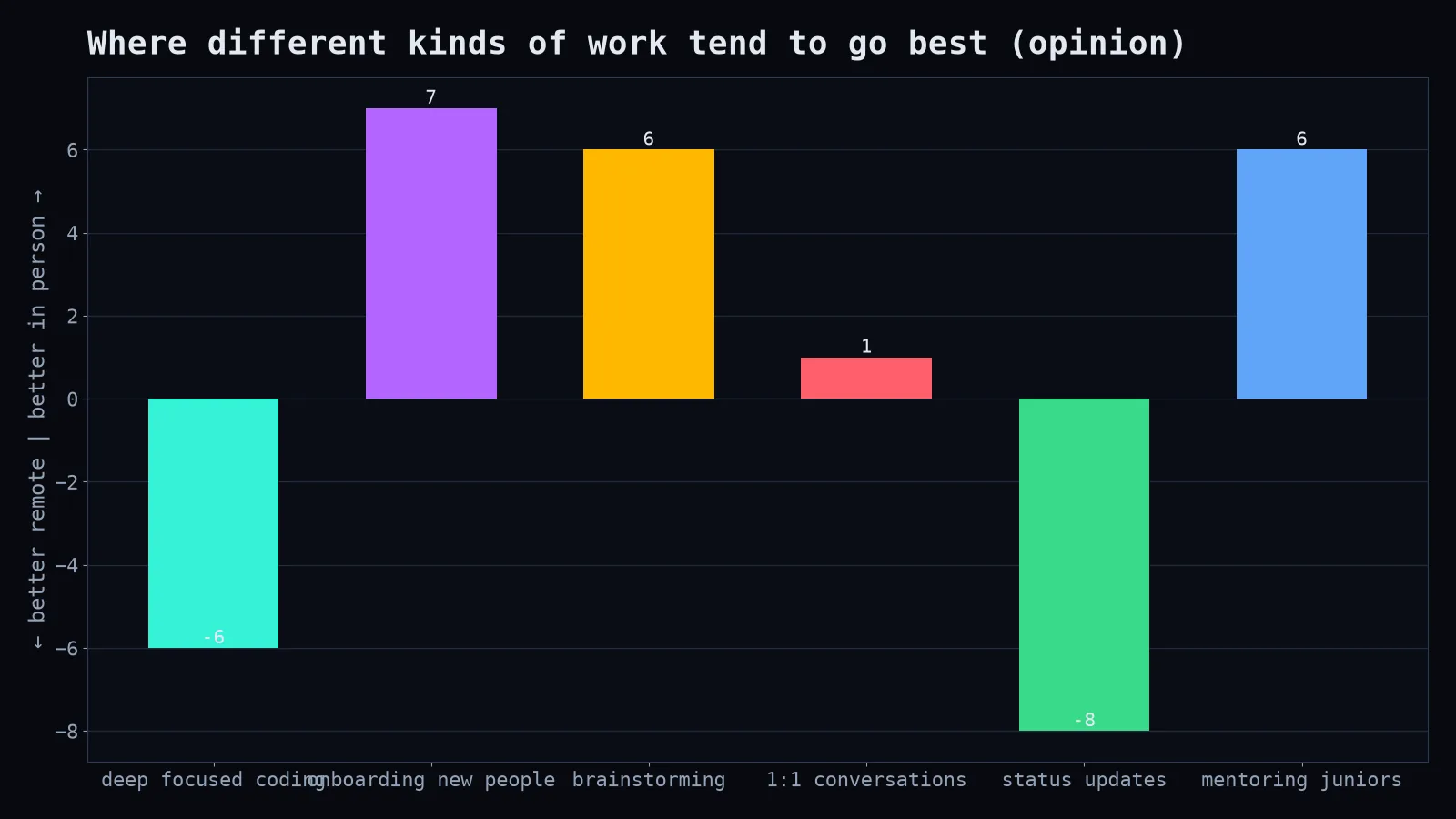
- Deep focus. No tapping on the shoulder, no open-plan noise, no "quick question" that takes 40 minutes.
- No commute. Hours returned every week, which many people spend on family, exercise or sleep.
- Hiring from anywhere. Companies can hire the best person, not the best person within an hour's drive.
- Accessibility. For many disabled people, carers and parents, remote work is the difference between working and not working.
What the office is genuinely good at
- Learning by osmosis. Juniors overhear how seniors solve problems, handle customers and argue productively. This is hard to replicate on video calls.
- Onboarding. New people ask more questions when they can see someone is free.
- Relationships. Trust builds faster over lunch than over a 30-minute agenda.
- Messy creative work. Whiteboard sessions where ideas bounce quickly.
The hybrid trap
Hybrid often goes wrong in a predictable way: people commute to the office, then spend the day on video calls with colleagues who stayed home. That's the commute without the benefit.
Hybrid works better when:
- Teams choose the same office days, so in-person time is actually shared.
- Office days are for collaboration: workshops, planning, mentoring, social time. Focus work happens at home.
- Meetings are remote-first when even one person is remote. One person on a laptop screen watching a room full of people talk is a terrible experience.
Making remote work actually work
- Write things down. Decisions, context and reasoning belong in documents, not in someone's memory of a call.
- Default to asynchronous communication for updates, and use meetings for discussion and decisions.
- Over-communicate progress, especially as a junior. Visibility doesn't happen by accident remotely.
- Protect boundaries. When home is the office, the office tends to expand into the evening.
- Meet in person occasionally. Even fully remote teams benefit from gathering once or twice a year.
For managers
Measure outcomes, not presence. If the only way you can tell whether someone is working is by seeing them sit at a desk, the problem is unclear goals, not the location.
My take
The best setup depends on the work, the team's stage and people's lives. A team of experienced engineers maintaining a stable product might thrive fully remote. A new team building something from scratch with several juniors probably benefits from regular in-person time. The worst answer is a blanket rule chosen by someone who doesn't do the work. The eternal standup will continue, but it would go faster if everyone admitted both sides are partly right.