Is $295 an Hour Enough in Canada? The Maths, With Sources
$295 an hour sounds like a fortune. Multiply it by a full-time year, 2,080 hours, and you get $613,600. That is the number people see when a consultant or contractor quotes a rate like this, and it is the number that makes the rate sound either outrageous or like a licence to print money.
Neither is right. This post works through where the money goes in Canada using Newfoundland and Labrador's 2026 rules, then sets the result against what it costs to live in St. John's, with every figure sourced so you can check it. The short answer: it depends almost entirely on how many hours you actually bill, and I will show the break-even points.
How to read the numbers. Figures in square brackets, like [1], point to the numbered sources at the end. Anything that is my assumption rather than a published figure is labelled assumption. This is not tax advice. I round to the nearest dollar or hundred and ignore smaller credits, so a real return can differ by a few hundred dollars.
Step 1: you cannot bill 2,080 hours
A full-time employee is paid for about 2,080 hours a year, holidays and sick days included. A contractor is paid only for the hours billed.
Take 46 working weeks at 40 hours: 1,840 working hours (assumption: four weeks off plus statutory holidays). Then remove the time spent finding the next client, writing proposals, invoicing, bookkeeping, tax, learning, and the gaps between contracts. Many independent people bill between 30% and 60% of their working hours. At 55%, that is about 1,000 billable hours. In the first year or two, 600 to 800 is common (assumption, from experience, not a published statistic).
Step 2: the HST is not yours
HST in Newfoundland and Labrador is 15%. Once you are registered you add it to invoices and remit it. A $295 hour appears as $339.25 on the invoice and you keep $295. I leave HST out of every figure below.
Step 3: you pay your own costs
An employer pays for an employee's laptop, software, insurance and training. A contractor does. This is an illustrative year (assumption; adjust it to yours):
- liability and professional insurance: $2,500
- computer and software: $5,000
- accountant and bookkeeping: $3,000
- office or co-working space: $3,600
- training, memberships and conferences: $2,000
- website and marketing: $1,500
- phone, internet share and travel: $2,400
That is $20,000, owed whether you billed 300 hours or 1,300.
Step 4: you pay both halves of CPP
For 2026 the self-employed Canada Pension Plan rate is 11.9% on earnings between $3,500 and $74,600 (maximum $8,460.90), plus 8% on earnings between $74,600 and $85,000 for CPP2 (maximum $832) [6]. The most you pay is $9,292.90. An employee pays half of that; the employer pays the matching half. The employer-equivalent half is deductible when you work out income tax.
Step 5: income tax
The 2026 federal brackets run from 14% to 33% [3], with a basic personal amount of $16,452 that reduces for high incomes [4]. Newfoundland and Labrador's run from 8.7% to 21.8% [5], with a basic personal amount of $13,094 [5]. Roughly:
- between about $117,000 and $160,000 of taxable income, the combined marginal rate is 41.8% (26% federal plus 15.8% provincial)
- above about $223,000 it is 48.8% (29% plus 19.8%)
What you take home at $295 an hour
This is the first chart: what remains of the $613,600 sticker price at 1,000 billable hours.
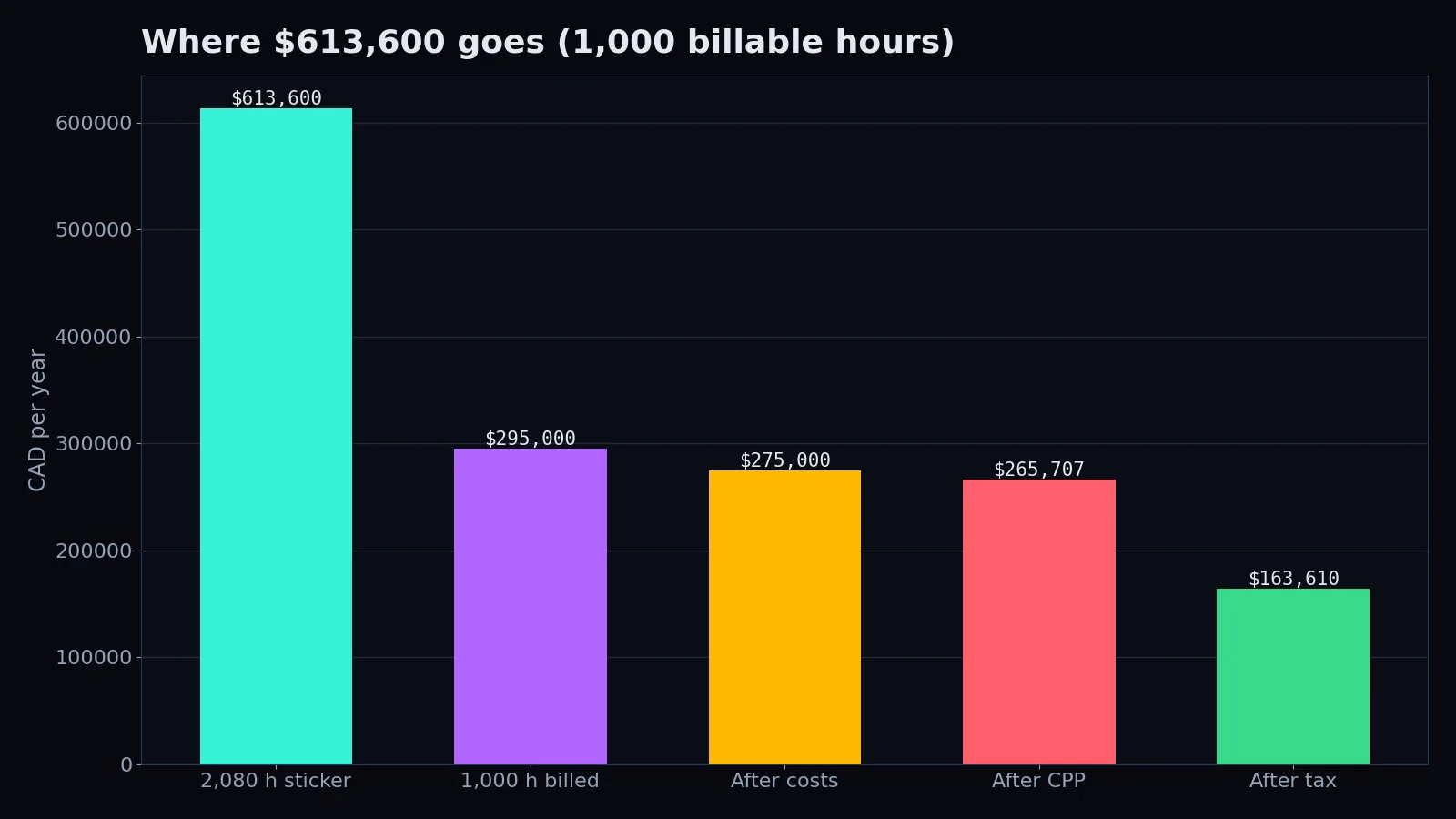
At other utilisation levels, using the same costs and rules:
- 400 billable hours: $118,000 billed, about $65,800 take-home
- 600 hours: $177,000 billed, about $101,500 take-home
- 800 hours: $236,000 billed, about $133,800 take-home
- 1,000 hours: $295,000 billed, about $163,600 take-home
- 1,200 hours: $354,000 billed, about $191,000 take-home
What it costs to live in St. John's
Statistics Canada's Market Basket Measure (MBM) prices a basket of food, clothing, transportation, shelter and other necessities for a reference family of two adults and two children. It describes a modest, basic standard of living, and the threshold is compared with disposable income, meaning money left after tax [1]. For St. John's in 2025 the threshold is $53,849:
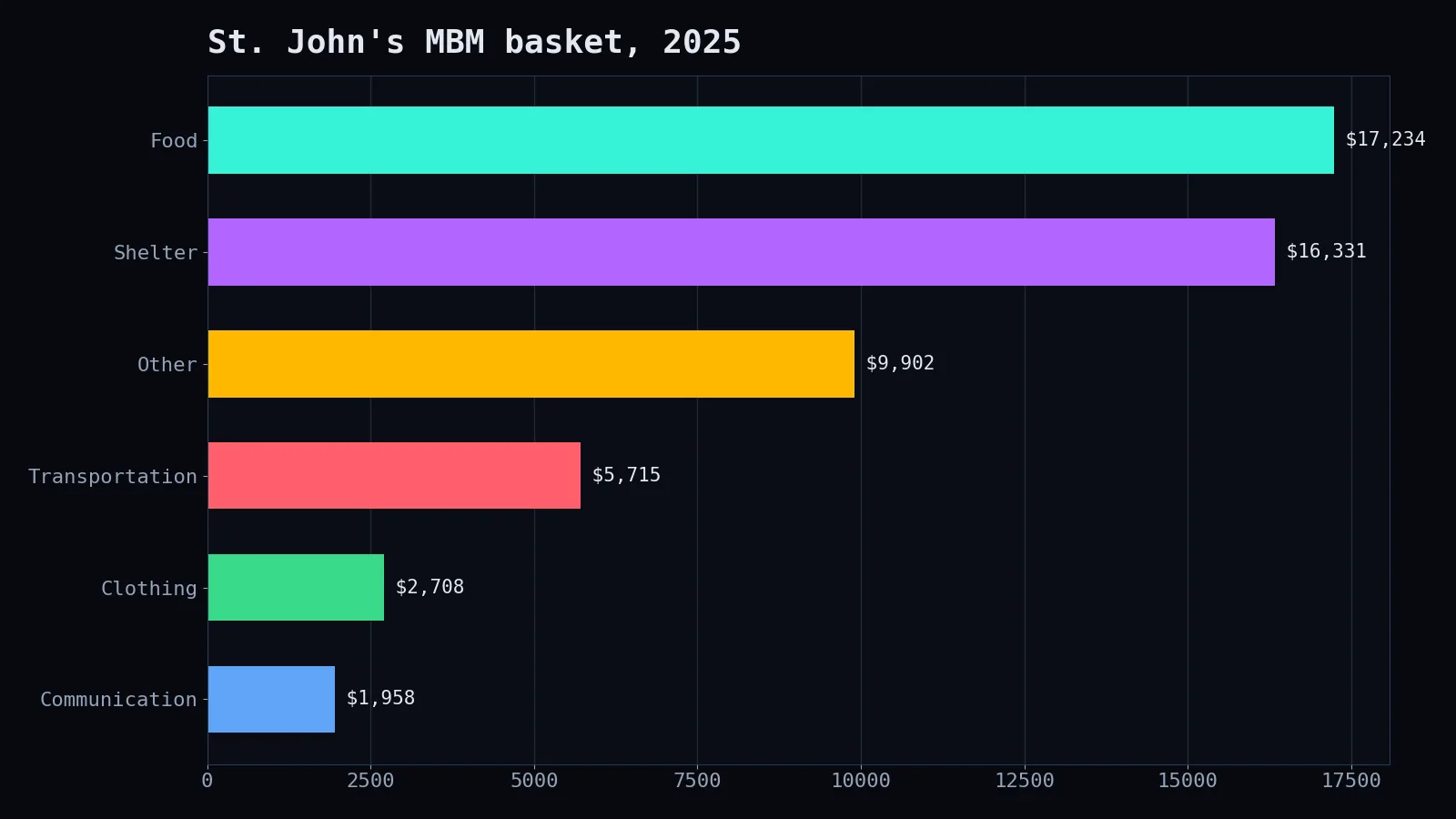
Three things to take from it. First, it is a floor, not a comfortable budget. As I read the method, it does not budget child care, retirement saving or most non-insured health costs. Second, food at $17,234 lines up with the national food-price forecast for a family of four of $17,571.79 in 2026 [8]. Third, shelter at $16,331 a year is about $1,361 a month, in line with CMHC's average two-bedroom rent of $1,348 in October 2025 [2].
Rent
CMHC's October 2025 survey, published through Statistics Canada's Table 34-10-0133-01, puts the average St. John's rent at $945 for a bachelor, $1,064 for a one-bedroom, $1,348 for a two-bedroom and $1,327 for a three-bedroom [2]. The two-bedroom average has risen quickly, from $1,018 in 2021 to $1,348 in 2025, an increase of 32%:
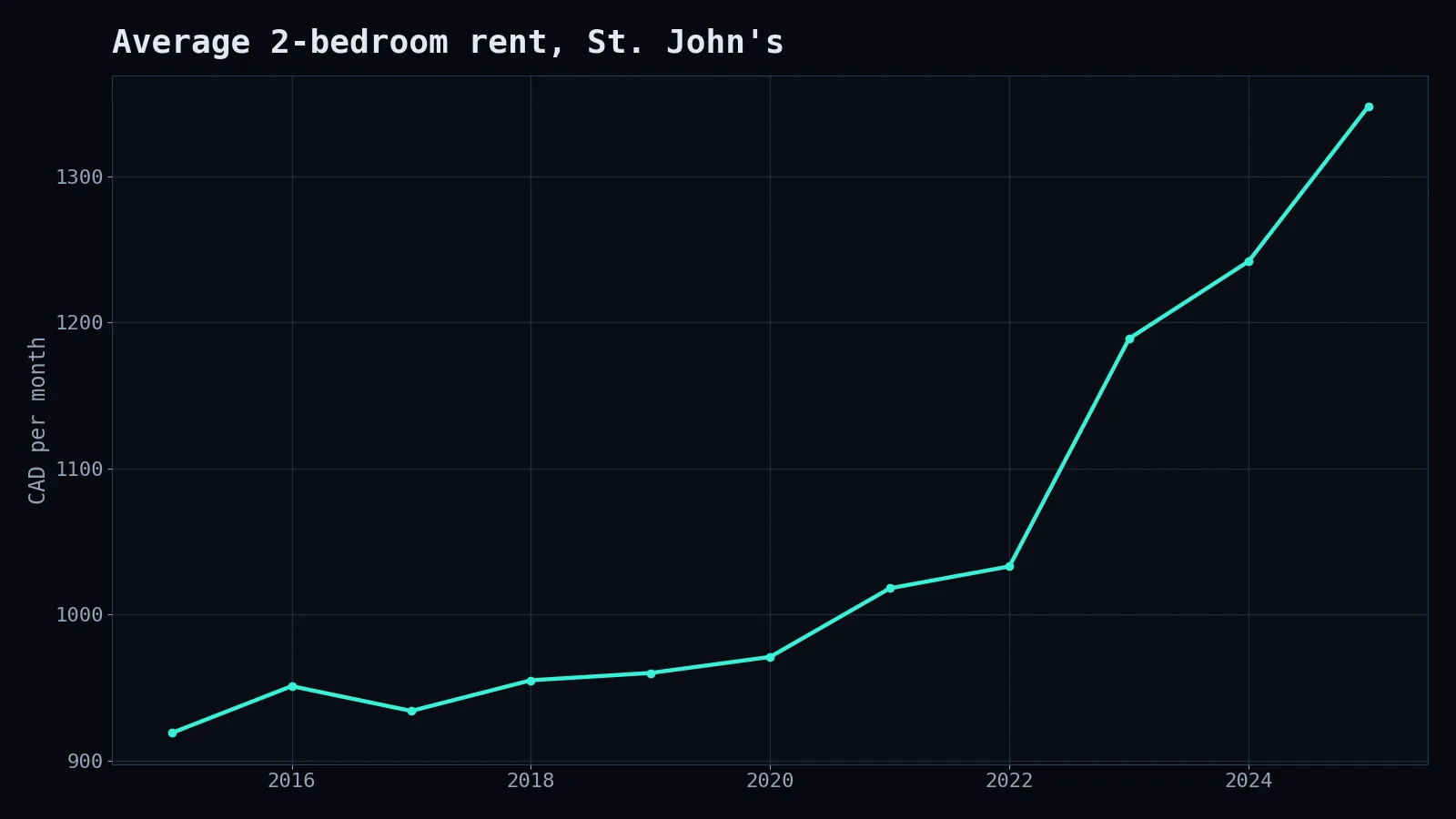
This is an average across existing tenancies in purpose-built rental buildings. It is lower than what a new tenant will usually be asked for on a fresh listing, so treat it as a floor too.
Buying a home
The Newfoundland and Labrador Real Estate Association reported an average St. John's home price of $427,000 as of July 2026, up about 10% in a year and from under $300,000 in 2021 [10]. As an illustration (assumption): 20% down, a 4.5% mortgage rate and a 25-year amortization gives a payment of about $1,899 a month ($22,785 a year). Add an allowance of 1.5% of the price a year for property tax, insurance and maintenance (assumption), about $6,405, and owning costs roughly $29,190 a year against $16,331 for the MBM's shelter.
Power
Newfoundland Power, which serves most of the island, reports average residential use of about 1,418 kWh a month in its rates effective July 1, 2026 [9]. The rate book sets the dollar amount; check it for your own bill. The point here is that the MBM's "shelter" line includes utilities, so electric heating in a cold, windy winter has to fit inside it.
How St. John's compares
Using the same MBM table for 2025 [1]:
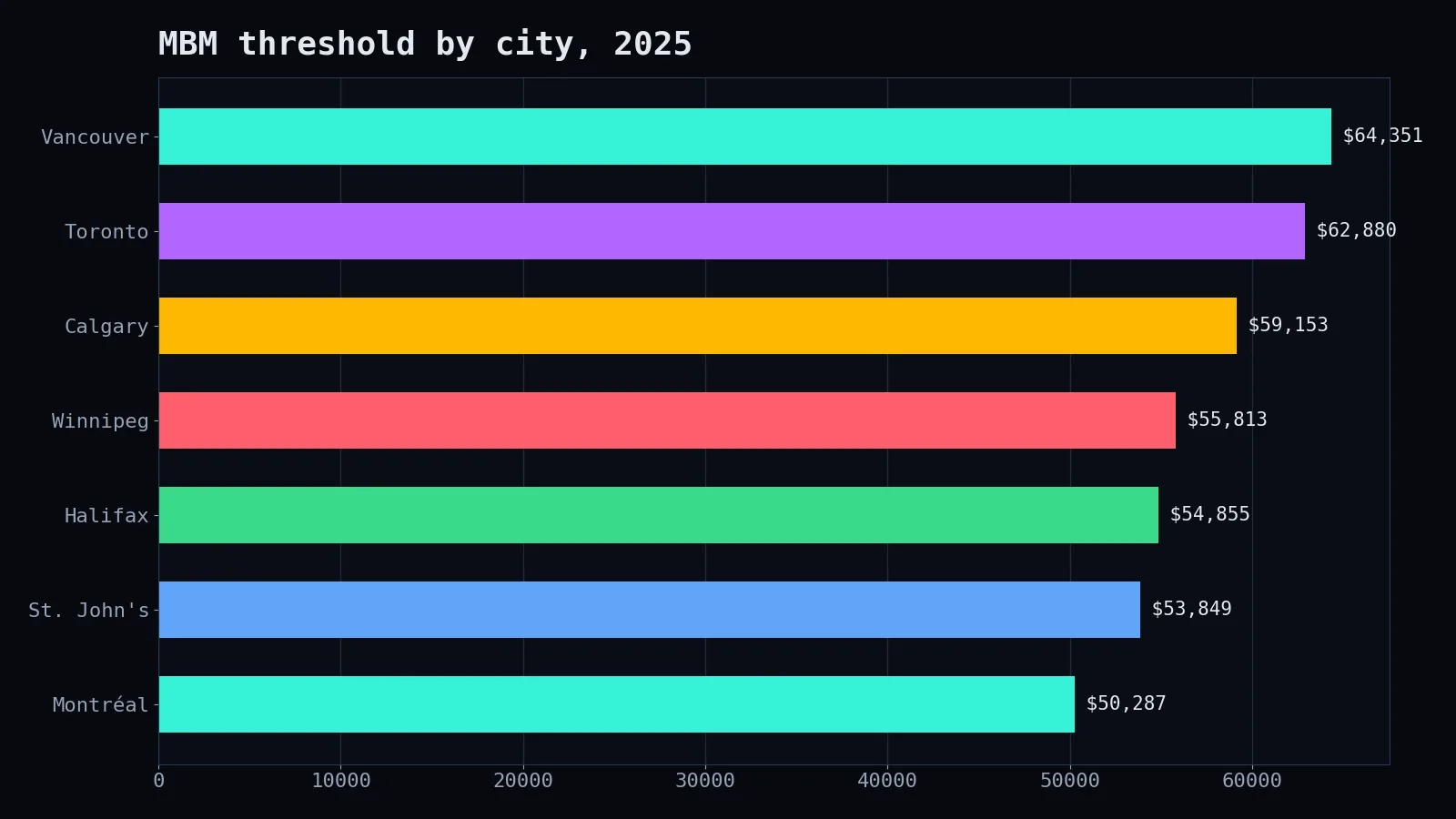
The same basket costs about $10,500 more a year in Vancouver ($64,351) and $9,000 more in Toronto ($62,880) than in St. John's ($53,849). Provincial taxes differ, so the take-home figures in this post are for Newfoundland and Labrador only.
Is $295 an hour enough?
Put the two sides together. Take-home at $295 an hour, set against the cost of living in St. John's and two salaried jobs, using the same tax rules:
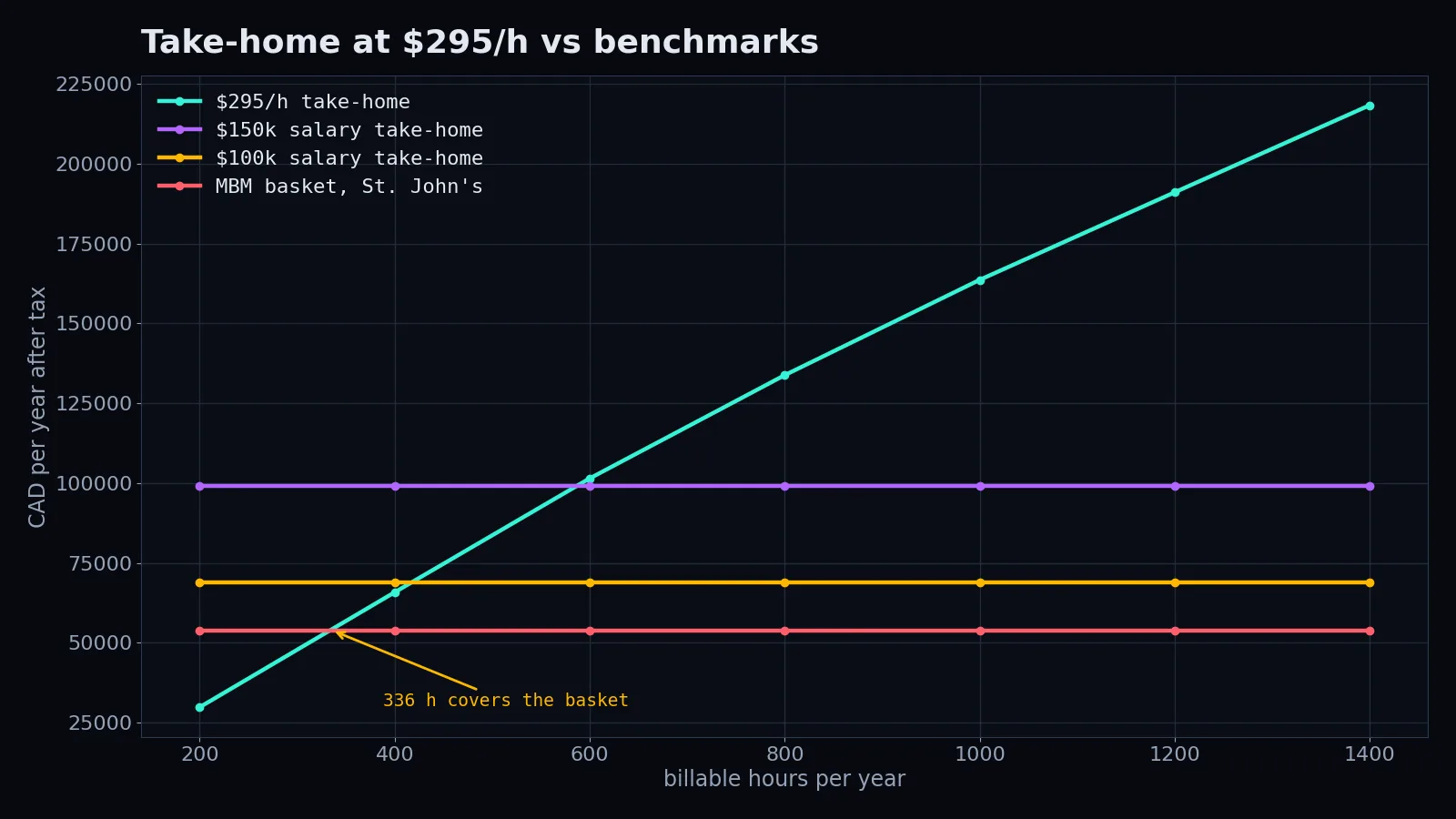
Reading the chart:
- Covering the modest basket ($53,849 take-home): about 336 billable hours a year. That is about 7 hours a week over 46 weeks.
- Owning the average home and saving $10,000 a year (assumption, on top of the basket with rent replaced by owning costs): about 458 billable hours, or just under 10 hours a week.
- Matching a $100,000 salary (take-home about $68,900): about 417 hours.
- Matching a $150,000 salary (take-home about $99,000): about 586 hours.
So in St. John's, $295 an hour is enough if you bill somewhere above about 450 to 600 hours a year, and comfortably more than enough at 1,000. The rate is not the weak point. The hours are.
What a salary gives you that the rate has to cover
A salaried job also comes with things a contractor buys with the same dollars:
- an employer pension or RRSP match
- health and dental cover
- paid sick, parental and vacation leave
- employment insurance coverage (self-employed people can opt in only to some benefits)
- someone else finding the work
Valued at 15% to 20% of salary (assumption), a $150,000 job is worth about $175,000 to the person holding it. To match that, with 800 to 1,000 billable hours, you would need roughly $210 to $260 an hour. A rate like $295 is sensible once you do that comparison.
When $295 genuinely is not enough
I want to be straight about the cases where it falls short. They are common:
- You bill under about 340 hours. You are below the modest basket for a family of four in St. John's, before any saving, child care or debt.
- You bill under about 420 to 590 hours. A salaried job at $100,000 to $150,000 beats you on take-home alone.
- You live in a more expensive city. The basket costs $9,000 to $10,500 more in Toronto or Vancouver [1], and rent and house prices there are higher.
- You carry child care, student debt or a mortgage above the average. The basket does not include them.
- You have one client who sets your hours. You carry contractor risk without contractor freedom.
- You price on 2,080 hours. If your rate is calculated as if you bill every working hour, it is too low by half.
How to use this
- Start from take-home, not from the hourly rate. Decide what your household needs after tax, then work backwards: add tax, CPP and costs, then divide by the hours you can really bill.
- Use the real basket. Add the things the MBM leaves out: child care, saving, debt, a car if you need one.
- Quote a day or project rate where you can. Hourly invites the client to count minutes.
- Put the gaps in the price. If you are idle one month in four, the rate carries that.
- Move 30% to 40% of every payment into a tax account until you know your own numbers.
- Ask an accountant about incorporating. At higher incomes it can change the picture, with its own costs and rules.
How I calculated it
The whole model is below, so you can run it yourself (Python). Every constant comes from the official tables in the sources.
INF = 1e12
FED = [(58523, .14), (117045, .205), (181440, .26), (258482, .29), (INF, .33)]
NL = [(44678, .087), (89354, .145), (159528, .158), (223340, .178), (285319, .198), (570638, .208), (1141275, .213), (INF, .218)]
NL_BPA = 13094

def _prog(x, brackets):
    tax, prev = 0.0, 0
    for limit, rate in brackets:
        if x > prev:
            tax += (min(x, limit) - prev) * rate
        prev = limit
    return tax

def fed_bpa(income):
    if income <= 181440:
        return 16452
    if income >= 258482:
        return 14829
    return 16452 - (16452 - 14829) * (income - 181440) / (258482 - 181440)

def income_tax(taxable):
    fed = max(0, _prog(taxable, FED) - fed_bpa(taxable) * .14)
    nl = max(0, _prog(taxable, NL) - NL_BPA * .087)
    return fed + nl

def self_employed(rate, hours, costs=20000):
    """Return (net business income, CPP+CPP2, income tax, take-home)."""
    net = rate * hours - costs
    cpp = max(0, min(net, 74600) - 3500) * .119
    cpp2 = max(0, min(net, 85000) - 74600) * .08
    tax = income_tax(net - cpp / 2 - cpp2 / 2)   # employer-equivalent half is deductible
    return net, cpp + cpp2, tax, net - cpp - cpp2 - tax

def employee(salary):
    cpp = max(0, min(salary, 74600) - 3500) * .0595
    cpp2 = max(0, min(salary, 85000) - 74600) * .04
    ei = min(salary, 68900) * .0163
    return salary - cpp - cpp2 - ei - income_tax(salary)
At 1,000 billable hours it gives net business income of $275,000, CPP of $9,293, income tax of about $102,100 and take-home of about $163,600. The salaried comparison uses the same tax function, with CPP at 5.95% (plus 4% CPP2) and EI at 1.63% up to $68,900 [6][7].
What is not in the model: the small non-refundable credit for CPP, the Canada employment amount, other credits and deductions, HST, and any income splitting or incorporation. All of them move the result by hundreds, not thousands, of dollars at these income levels.
Sources
All accessed 14 October 2026.
- Statistics Canada. Market Basket Measure (MBM) thresholds for the reference family by MBM region, component and base year, Table 11-10-0066-01. www150.statcan.gc.ca. St. John's 2025, current dollars: total $53,849; food $17,234; shelter $16,331; other $9,902; transportation $5,715; clothing $2,708; communication $1,958.
- Statistics Canada, from CMHC's Rental Market Survey. Canada Mortgage and Housing Corporation, average rents for areas with a population of 10,000 and over, Table 34-10-0133-01. www150.statcan.gc.ca. St. John's, row and apartment structures of three units and over, 2025: bachelor $945, one bedroom $1,064, two bedroom $1,348, three bedroom $1,327.
- Canada Revenue Agency. Canadian income tax rates for individuals, current year (2026). canada.ca.
- Canada Revenue Agency. Adjustment of personal income tax and benefit amounts, 2026 indexation (2.0%; federal basic personal amount $16,452 to $14,829). canada.ca.
- Government of Newfoundland and Labrador, Department of Finance. Personal Income Tax (2026 rates, brackets and basic personal amount $13,094). gov.nl.ca.
- Employment and Social Development Canada. Maximum benefit amounts and related figures, Canada Pension Plan (2026), Table 3, contribution rates and annual maximums. canada.ca.
- Canada Revenue Agency. EI premium rates and maximums (2026: 1.63%, maximum insurable earnings $68,900). canada.ca.
- Dalhousie University and partners. Canada's Food Price Report 2026 (family of four, forecast $17,571.79 in 2026). dal.ca.
- Newfoundland Power. Residential rates (effective July 1, 2026; average use 1,418 kWh a month). newfoundlandpower.com.
- VOCM. "Housing Demand Continues to Outpace Supply in NL says Real Estate Association", 26 August 2026 (average St. John's price $427,000 as of July 2026). vocm.com.