The Pomodoro Technique, Tested on a Professional Procrastinator
I'm a gifted procrastinator. I can turn "write one email" into reorganising my desktop, reading about the history of fonts and making a third cup of tea. So when a friend suggested the Pomodoro Technique, I agreed mostly to have something to procrastinate about.
The technique
- Pick one task.
- Set a timer for 25 minutes and work on only that task.
- Take a 5-minute break.
- After four rounds, take a longer break (15–30 minutes).
It was created in the late 1980s by Francesco Cirillo, who used a tomato-shaped kitchen timer. "Pomodoro" is Italian for tomato, which is the most charming origin story in productivity.
Why it works on procrastinators
Procrastination is often less about laziness and more about avoiding an unpleasant feeling: the task feels big, vague or boring. Pomodoro shrinks the commitment. "Write the report" is daunting. "Work on the report for 25 minutes" is survivable. And starting is the hardest part; once started, momentum often carries you.
What a week of trying it tends to look like
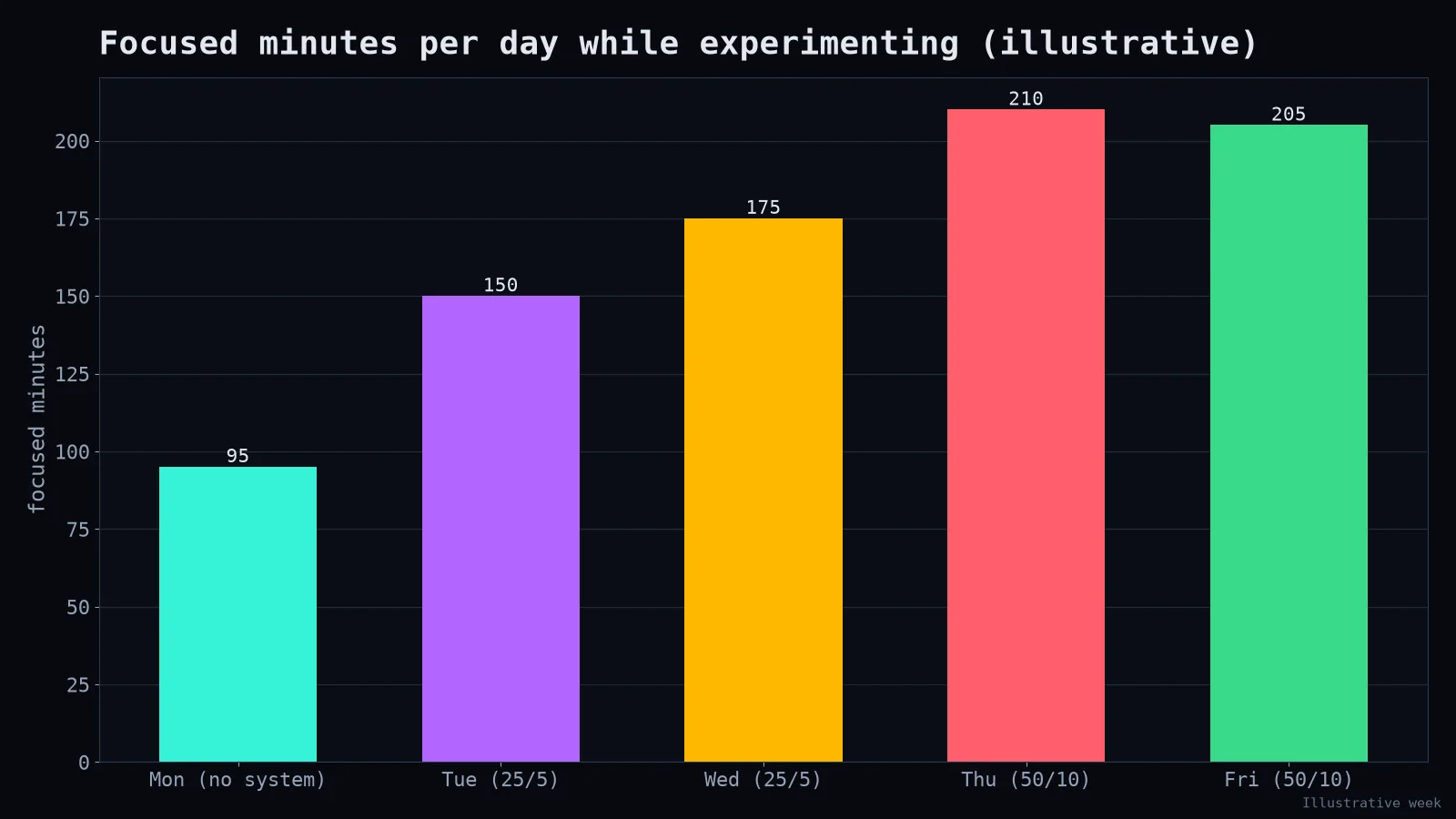
- Day 1 without a system: lots of "working," little focus.
- Days 2–3 with 25/5: a big jump. The timer made it easy to start and to ignore messages ("I'll reply in 12 minutes").
- Days 4–5 with 50/10: even better for coding and writing, where 25 minutes felt like it ended just as I got into the problem.
One person, very unscientific. But the direction was clear enough to keep going.
What didn't work
- Rigid timers during flow. Stopping mid-thought when the bell rings is painful. Now, if I'm in flow, I finish the thought and take the break after.
- Breaks spent on the phone. Scrolling isn't rest; it's a different kind of input. Walking, stretching, refilling water and looking out of a window work much better.
- Vague tasks. "Research stuff" fails even with a timer. "Read two papers and write three notes" works.
Tweaks that made it stick
- Adjust the length to the work: 25 minutes for admin and boring tasks, 45–50 minutes for deep work.
- Write the next tiny step before each round: "write the introduction's first paragraph," not "work on paper."
- Keep a distraction list. When a thought pops up ("check flight prices!"), write it down and return to the task. Deal with the list at a break.
- Count rounds, not hours. "Six pomodoros today" is a satisfying, achievable target.
A simple timer, if you want one
# macOS / Linux: 25-minute focus timer in the terminal
pomo() { sleep $((${1:-25} * 60)) && echo "Break time!" && say "break time" 2>/dev/null; }
pomo 25
The verdict
The Pomodoro Technique didn't cure my procrastination. It did something more useful: it made starting easy and made focus visible. I still reorganise my desktop sometimes. I just do it in the five-minute break, where it belongs.