Will AI Take My Job? A Calm, Mildly Sarcastic Analysis
Every few months a headline announces that AI will replace some huge percentage of jobs, and every few months my phone lights up with messages from friends asking whether they should quit and become plumbers. (Plumbing is a great career, to be clear. Just not because of a headline.)
Let's slow down and think about it properly.
Jobs are bundles of tasks
Nobody's job is one thing. A data analyst writes SQL, cleans spreadsheets, builds charts, explains results to people who don't read charts, argues about definitions of "active user," and spends a startling amount of time in meetings about meetings.
AI doesn't take jobs in one bite. It eats tasks, one at a time, starting with the ones that are repetitive, well-defined and easy to check.
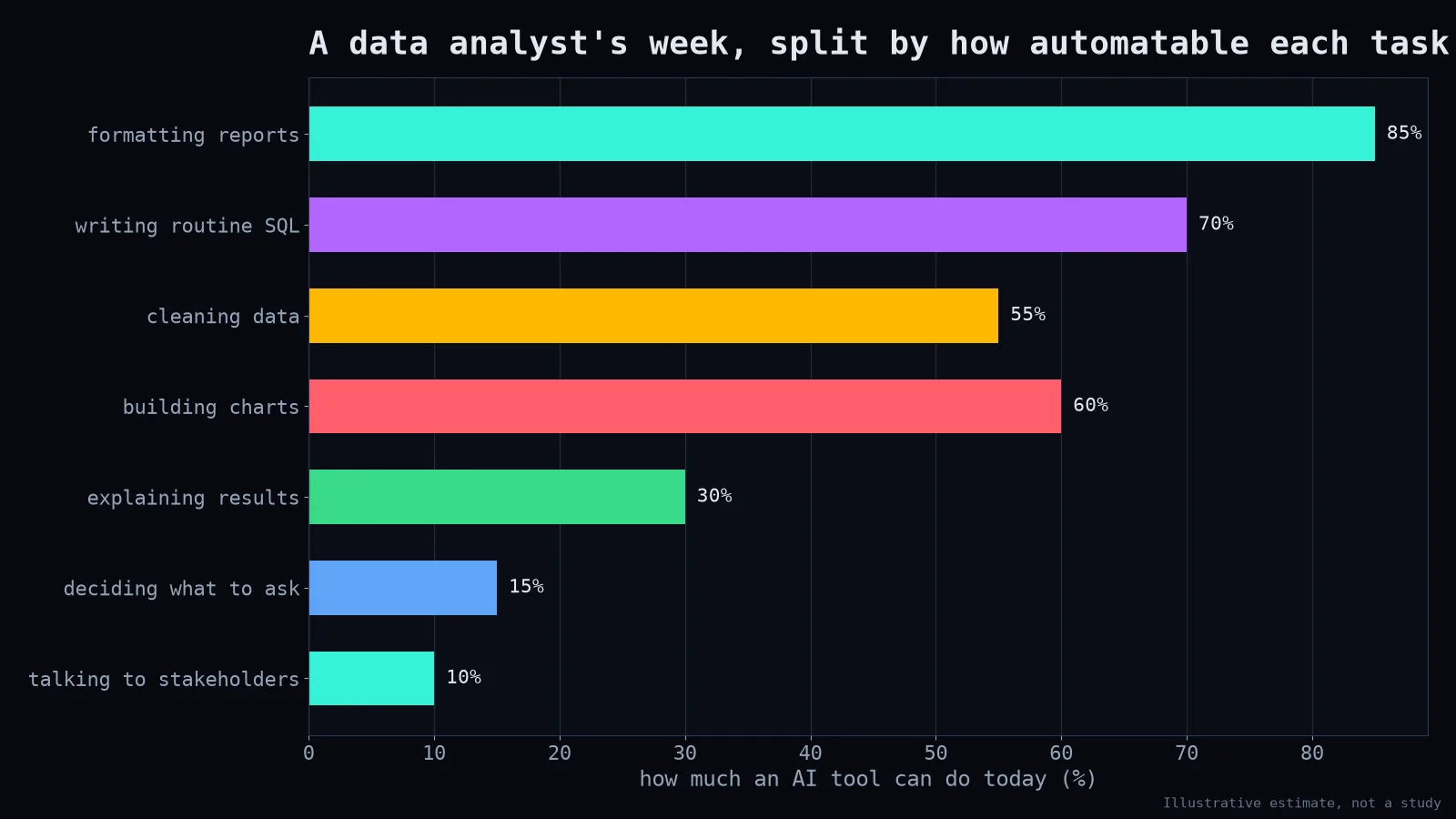
Look at the bottom of that chart: deciding what question to ask, understanding what the business actually needs, convincing people, taking responsibility. Those are hard to automate, and they also happen to be what gets people promoted.
What usually happens
When a tool makes a task much cheaper, three things tend to happen:
- The boring part shrinks. Fewer hours formatting reports.
- Expectations rise. Your manager now wants three reports instead of one, with more depth.
- The role shifts. The people who adapt take on more judgement and less typing. The people who refuse to use the tool find themselves competing with colleagues who do.
That's not utopia. Some roles genuinely shrink, and entry-level work, the stuff juniors used to learn on, is especially exposed. That's a real problem for how people start careers, and companies should take it seriously instead of pretending it isn't happening.
A practical exercise
Write down everything you did last week. For each task, ask:
- Could an AI tool do a first draft of this today? If yes, learn to use that tool well. Don't fight it; supervise it.
- Does this task need context only I have? Relationships, history, domain knowledge, the unwritten rules of your organisation. Invest here.
- Am I accountable for the outcome? Accountability doesn't automate. Someone has to sign off.
What to learn
- Use the tools daily. Not to become a "prompt engineer," just to know what they're good and bad at in your field.
- Get deeper in your domain. An accountant who understands AI beats both an accountant who doesn't and an AI that doesn't understand accounting.
- Communication. Explaining, persuading and writing clearly are becoming more valuable, not less, because AI produces a flood of mediocre text and clarity stands out.
- Judgement. Knowing when an answer is wrong is the skill that makes AI output safe to use.
The mildly sarcastic conclusion
AI probably won't take your job. A person who uses AI well and understands your field might take a big chunk of it, though. The good news is that person can be you, and the training costs less than a plumbing apprenticeship. Although, again, plumbers are doing great.