The Ethics Talk Nobody Wants at Standup
It's Monday standup. Someone says "the model's accuracy is 91%, we're good to ship," and everyone nods. Then one person asks, "91% for whom?" and the room gets very quiet, the way a room does when someone mentions money at a wedding.
That quiet is the ethics talk. Let's have it, briefly and practically.
Averages hide people
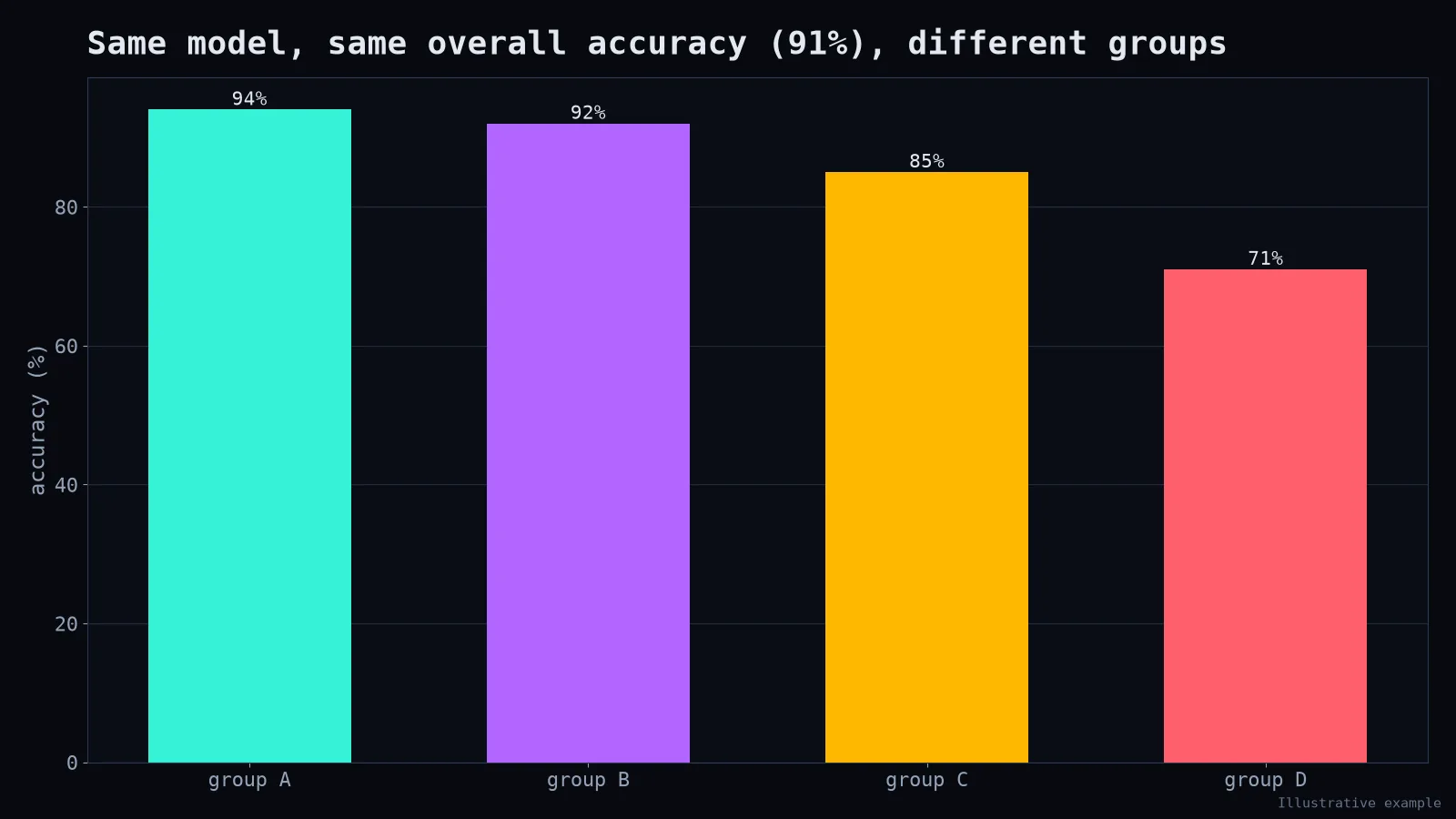
An overall accuracy of 91% can mean 94% for one group and 71% for another. If group D is people with a particular accent, or older users, or people whose names the training data rarely saw, they get a product that works much worse for them, and they'll never see your nice average.
Practical fix: break your evaluation metrics down by relevant groups before shipping. If a gap appears, collect more representative data, adjust thresholds, or limit where the model is used.
Data has a history
Models learn from past data, and past data contains past decisions. If historically certain applicants were rejected more often, a model trained to imitate those decisions will learn to reject them too, very efficiently, at scale, with a confidence score.
Ask: what is this data a record of? Sometimes the honest answer is "past bias, labelled as ground truth."
Privacy is a design decision
- Do you need that field? If not, don't collect it.
- How long do you keep logs of user prompts? Forever is a choice, and usually a bad one.
- Could someone reconstruct personal information from your model's outputs?
- Do users know their data trains your next version?
Privacy problems are much cheaper to prevent in the schema than to fix after a breach.
People need a way to say "that's wrong"
If a model decides something that matters, like a loan, an insurance claim, a moderation ban or a job application filter, people need to know a model was involved and have a real way to appeal to a human. "The algorithm decided" is not an explanation; it's an abdication.
Someone has to own it
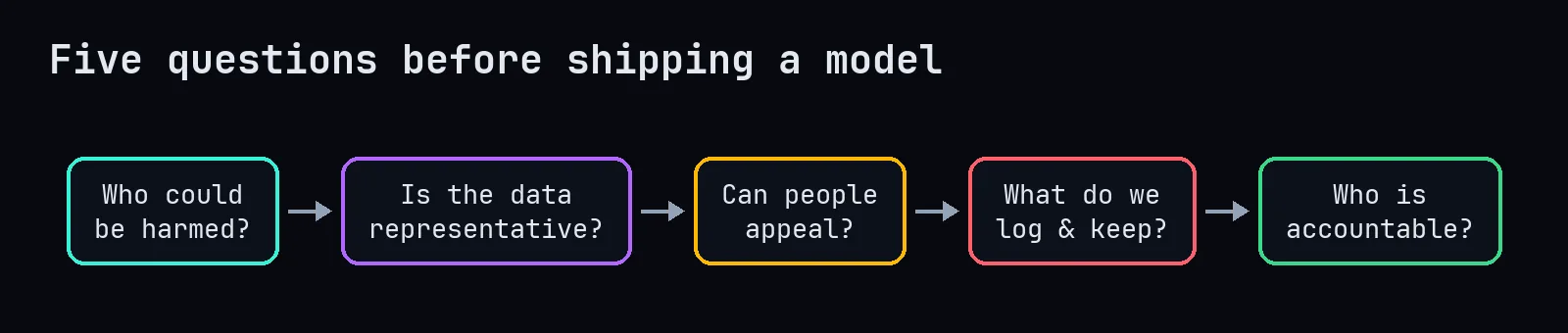
Every model in production should have a named owner who is responsible for monitoring it, fixing it and turning it off if needed. "The team" is not an owner. "The vendor" is not an owner.
Why this belongs at standup
Because these are engineering decisions: which data, which metric, which threshold, what to log, what to show users. They're made in tickets and pull requests, not in ethics seminars. The quiet moment at standup is uncomfortable, but it's much less uncomfortable than the headline that comes later.
Ask "for whom?" Every time. Be the annoying person. Somebody has to.