Return-to-Office Mandates: A Data Person's Take

Every few months, another large company announces that employees must return to the office several days a week, and the internet splits into two armies, each carrying a study.
As a data person, what I find most interesting isn't who's right. It's how both sides can cite evidence and still disagree completely.
Different studies measure different things
Research on remote work has looked at many outcomes, and they don't all point the same way:
- Some studies of individual, measurable tasks (like call-centre work) found remote workers equally or more productive.
- Some research suggests that fully remote setups can make communication networks more siloed and slow down certain kinds of collaboration and innovation.
- Several studies have found hybrid arrangements improve retention and satisfaction without clear productivity losses.
- Others raise concerns about junior employees getting less feedback and mentoring remotely.
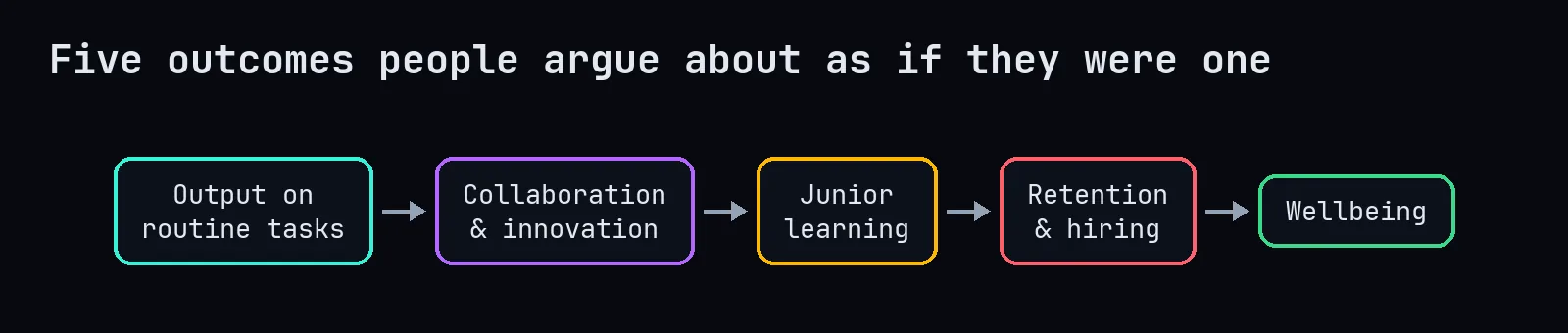
These aren't contradictions. They're answers to different questions. "Is remote work productive?" is too vague to have one answer.
The measurement problem
Knowledge work is notoriously hard to measure. Lines of code, tickets closed and hours online are poor proxies for value. When something is hard to measure, people often fall back on what's visible: presence. That's partly why office mandates appeal to some managers, and partly why they frustrate employees whose output hasn't changed.
Confounders everywhere
- Companies that went remote may differ from those that didn't (industry, age, size).
- People who choose remote work may differ from those who choose the office.
- The pandemic period changed everything at once, making clean comparisons hard.
- Mandates are sometimes partly about other goals: reducing headcount through attrition, justifying office leases, or company culture preferences.
How I'd decide, as a data-minded manager
- Define the outcome you care about. Speed of delivery? Quality? Junior development? Retention? Innovation?
- Look at your own data, with the confounders in mind. Did delivery actually slow down? Did attrition change?
- Consider different rules for different work. Teams with heavy onboarding needs may benefit from more in-person time; experienced, focused teams may not.
- Ask people. Surveys aren't perfect, but ignoring employees' experience is worse.
- Run it like an experiment. Try a policy for a defined period, measure, and adjust. Announce it as a test, not a permanent truth.
My opinion, labelled as such
Blanket mandates applied identically to every team seem unlikely to be optimal, and so does an absolute refusal to ever meet in person. The evidence, taken together, points toward flexibility designed around the actual work, with intentional in-person time for the things offices are good at.
And whichever side you're on, check whether your favourite study measured the thing you're claiming it proves. That habit alone would improve most of these debates.