The Passive Income Course That Taught Me to Sell Passive Income Courses
The ad promised "passive income while you sleep." I clicked, mostly out of professional curiosity and partly because I am, like everyone, tired.
The free masterclass
The "free masterclass" was a 90-minute video, of which roughly 8 minutes contained information. The rest was the host's backstory (broke, then enlightened, then rich), photos of beaches, testimonials from people with very white teeth, and a growing sense that the actual content would arrive shortly. It did not. Instead, an offer appeared.
The offer
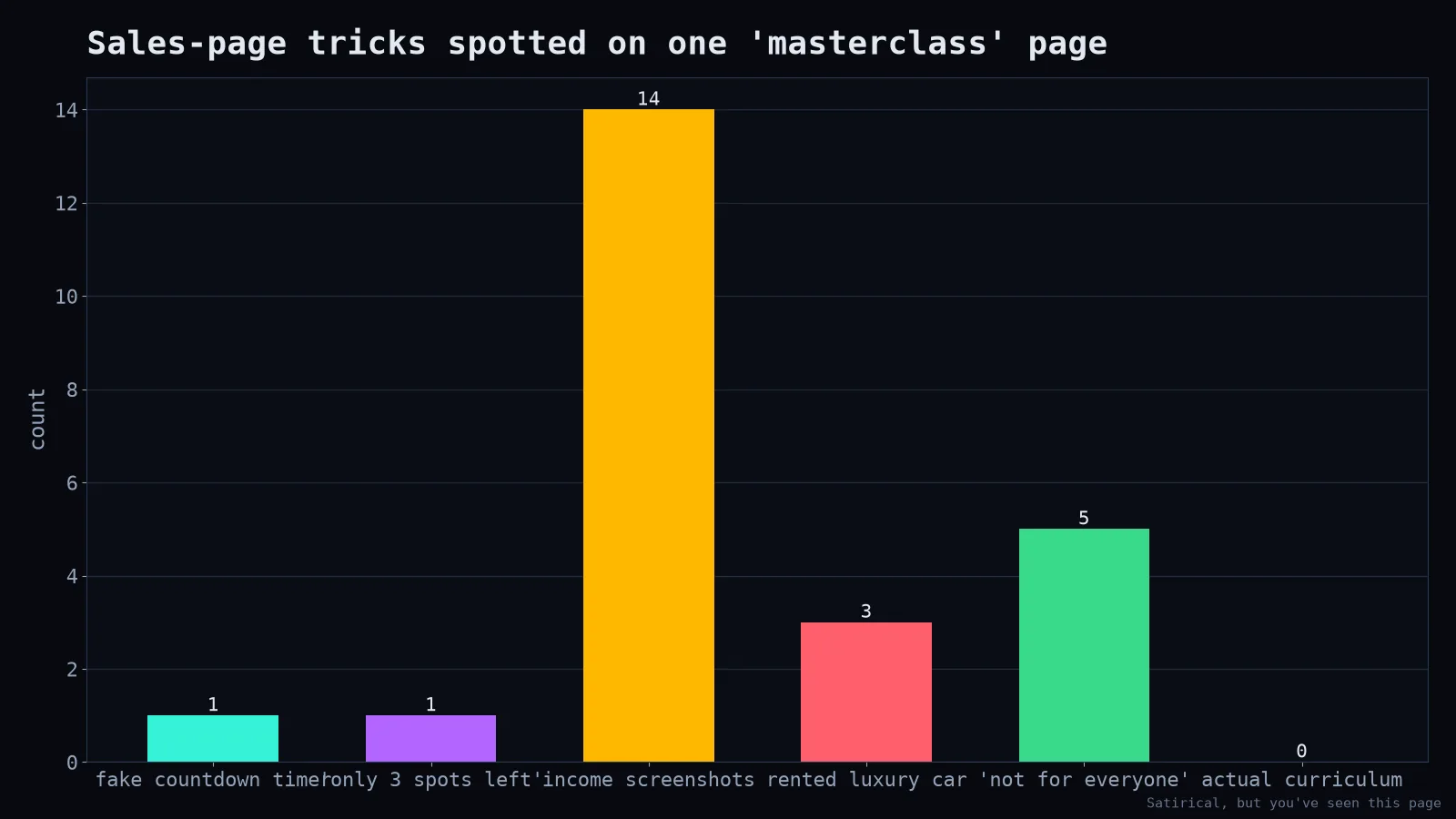
A $1,997 course, discounted to $997 for the next 15 minutes, with a countdown timer. (Reload the page and the timer starts again. Time, it turns out, is also passive.)
What the course teaches
After all the modules, the core secret was this: create an online course about how to make passive income, and sell it using a free masterclass with a countdown timer.
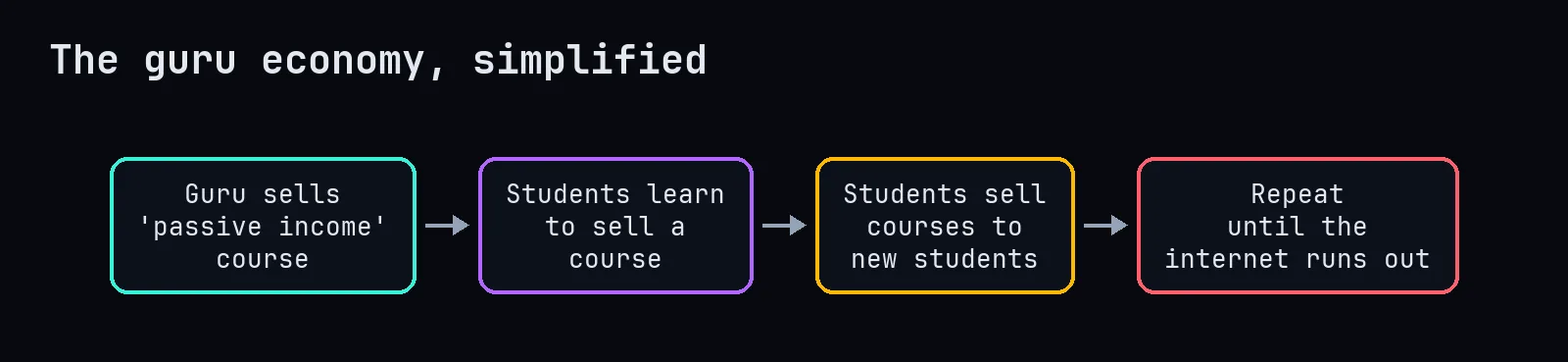
It's an elegant system. It just needs an infinite supply of new beginners at the bottom, which is a problem with every system shaped like this.
The psychological tricks, decoded
- Artificial scarcity: "only 3 spots left" for a video course that can be sold infinitely.
- Fake urgency: countdown timers that reset.
- Social proof: cherry-picked testimonials, often from people who sell their own courses.
- Status signalling: cars, villas and first-class seats, sometimes rented for the shoot.
- Identity hooks: "this isn't for everyone, only for people who want freedom." Who doesn't want freedom?
- The sunk-cost upsell: after the course comes the "inner circle," the "mastermind," and the $10,000 "coaching."
"Passive" income isn't passive
Real income that keeps coming without daily work exists: rent from property, dividends from investments, royalties from a book or software people keep buying. But all of them required a lot of active work or capital first. Writing a book is not passive. Building software is not passive. The income can become passive; the work never was.
How to spot a real course
Good courses exist. I've learned a lot from them. Signs of a legitimate one:
- a detailed, public curriculum
- an instructor with verifiable expertise in the subject, not in selling courses
- reasonable price with a clear refund policy
- reviews from people who used the skill, not just people who loved the vibe
- no countdown timers, no "only 3 spots left"
The honest course I'd sell
"How to Build Wealth, Module 1: Spend less than you earn. Module 2: Invest the difference in diversified, low-cost funds. Module 3: Wait. Module 4: Keep learning skills people will pay for." Price: free. Testimonials: compound interest. Unfortunately, it doesn't need a Lamborghini, so it doesn't sell.