Gradient Descent Is Just Walking Downhill Blindfolded
Imagine you're on a hill in thick fog. You want to reach the lowest point of the valley, but you can't see more than a step ahead. What do you do?
You feel the ground with your feet, figure out which direction slopes down most steeply, and take a step that way. Then you do it again. And again. Eventually, you reach the bottom (or at least a bottom).
That's gradient descent. That's genuinely most of it.
Translating the hill into maths
- Your position is the model's parameters (the weights).
- The height is the loss: how wrong the model currently is.
- The slope under your feet is the gradient: how the loss changes if you nudge each weight.
- Your step size is the learning rate.
Each step, you update the weights a little in the direction that reduces the loss:
weights = weights - learning_rate * gradientA tiny example you can run
Fit a line y = w * x to some points:
import numpy as np

x = np.array([1, 2, 3, 4, 5], dtype=float)
y = np.array([2.1, 3.9, 6.2, 8.1, 9.8])   # roughly y = 2x

w = 0.0
lr = 0.01
for step in range(200):
    pred = w * x
    grad = 2 * np.mean((pred - y) * x)   # derivative of mean squared error
    w -= lr * grad

print(round(w, 3))   # close to 2
No magic. Just "which way is downhill?", over and over.
The learning rate is everything
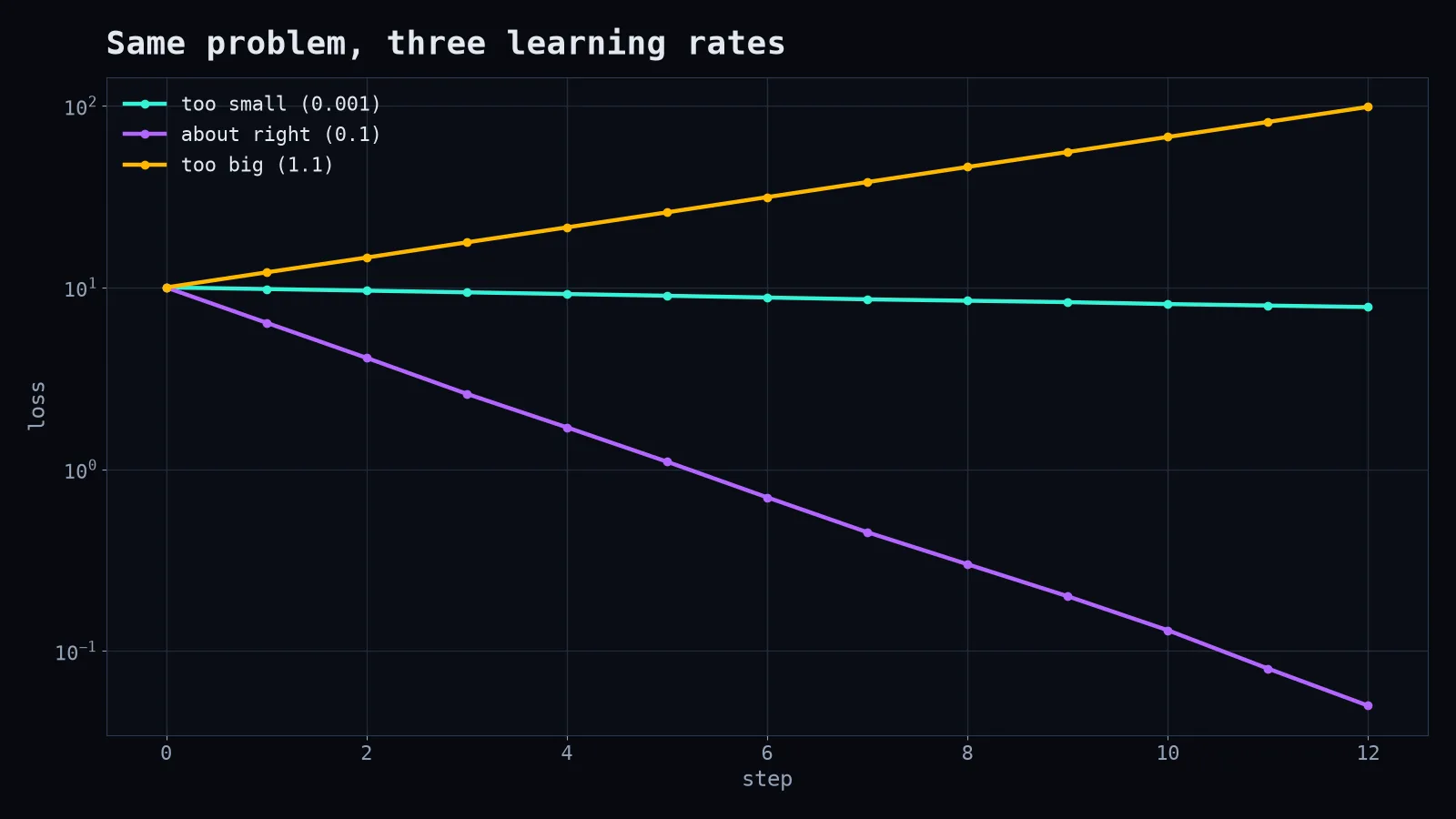
- Too small: you take tiny shuffling steps and will reach the bottom sometime next year.
- About right: steady progress, then slowing down as you approach the bottom.
- Too big: you leap over the valley, land higher on the other side, leap back even higher, and the loss explodes. If you've ever seen your loss become
NaN, you've met an overly brave hiker.
Real-world upgrades
Plain gradient descent has been upgraded many times:
- Stochastic / mini-batch: estimate the slope from a small random batch instead of all the data. Noisier, much faster, and the noise can even help you escape bad spots.
- Momentum: keep some of your previous direction, like a ball rolling downhill, so you don't zig-zag.
- Adam: adapts the step size for each parameter automatically. It's the default choice for many deep learning projects because it works decently without much tuning.
- Learning rate schedules: take big steps early, smaller steps later, like slowing down as you approach the parking spot.
The honest caveat
Real loss landscapes have millions of dimensions, flat plateaus and many valleys. Gradient descent doesn't guarantee the best valley, only a reasonably low one. Surprisingly, for large neural networks, "reasonably low" turns out to be very good.
So next time someone says a model "learned," picture a blindfolded hiker on a foggy hill, carefully feeling for the downward slope, billions of times. It's less mystical than it sounds, and much more impressive.