Everyone Is an "AI Company" Now
I recently saw "AI-powered" on a toothbrush, a washing machine and a calendar app whose "AI" turned out to be a feature that suggests 9 AM for meetings. Every company is now an AI company, in the same way that every company became a "dot-com" in 1999 and a "blockchain company" around 2017.
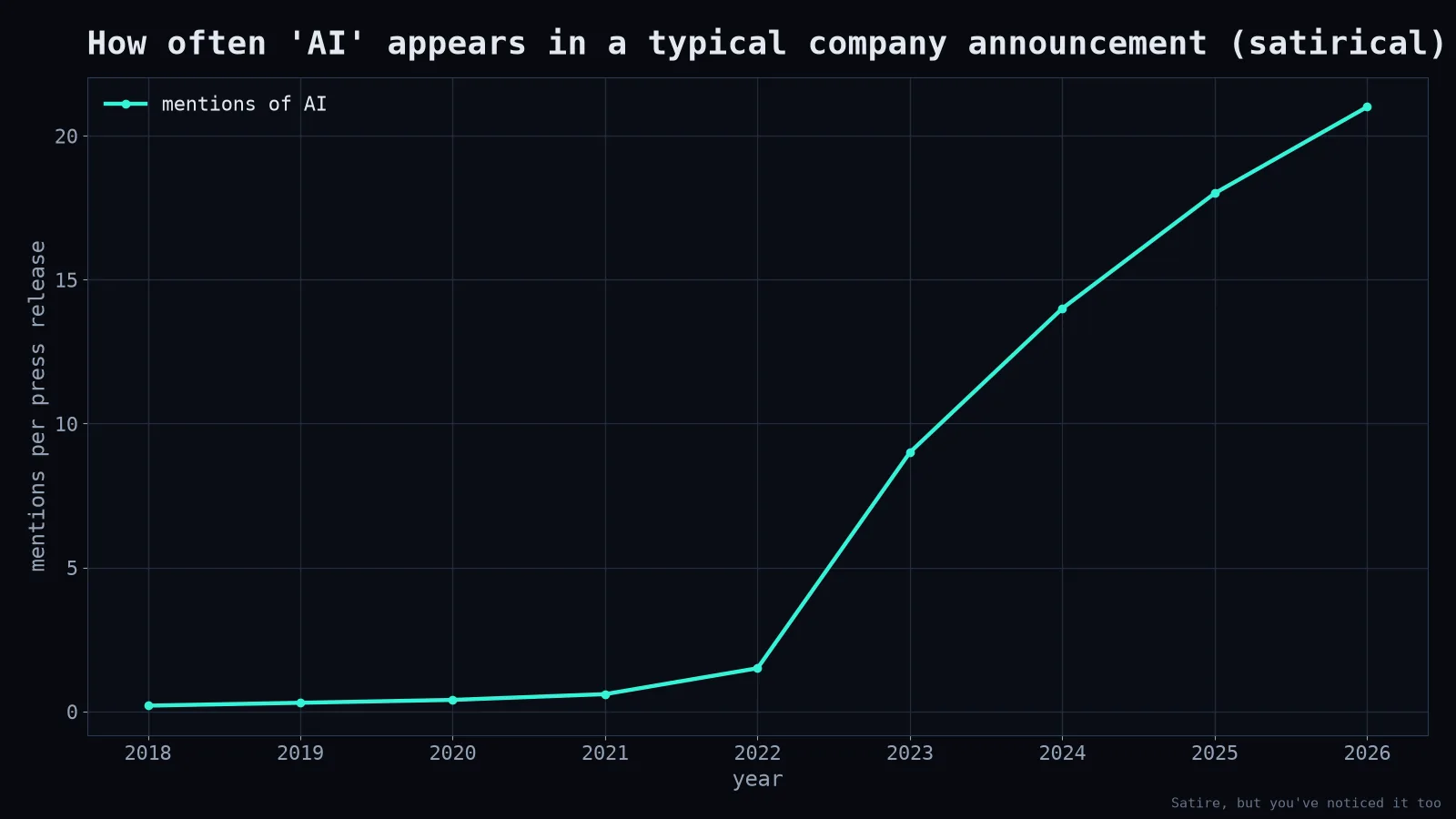
Why everyone says it
- Investors reward it. "AI" in a pitch deck can change how a company is valued.
- Customers expect it. Products without AI features can look outdated, even if they work perfectly.
- It's genuinely easier now. Powerful models are available through APIs, so adding a chatbot or a summary button takes days, not years.
- Fear of missing out. No executive wants to explain to the board why they didn't "do AI."
That last reason produces the most questionable products.
Real AI vs rebranded if-statements
Questions I ask when something claims to be AI-powered:
- What does the AI actually do? "It summarises your meeting notes" is concrete. "It leverages AI to empower your workflow" is fog.
- Would it work without the AI? If removing the AI part changes nothing important, it's decoration.
- What happens when it's wrong? Real products design for mistakes: confidence indicators, human review, easy correction. Hype products pretend mistakes don't happen.
- Where does my data go? Is it used to train models? Stored? Shared with a third party?
- Is it measurably better? Faster, cheaper, more accurate than the old way, with numbers rather than adjectives.
The good news inside the hype
Hype cycles always leave something useful behind. The dot-com bubble burst, but online shopping, search and email stayed. Many current AI features will vanish quietly. Others, like better translation, transcription, coding assistance, accessibility tools and document search, are already genuinely useful and will stick.
For people building products
- Start with a problem your users actually have, not with "we need AI."
- Use AI where uncertainty is acceptable or checkable; keep deterministic code where precision matters (billing, permissions, safety).
- Measure the feature honestly after launch. If nobody uses the AI button, that's information.
- Be truthful in marketing. Overclaiming AI capabilities can mislead customers, and regulators in several countries have started paying attention to exaggerated AI claims.
For everyone else
Treat "AI-powered" like "natural" on a food label: it might mean something, it might mean nothing, and you have to read the ingredients. The toothbrush, by the way, tracked brushing time with a sensor. Useful! Just maybe not artificial intelligence. Maybe artificial enthusiasm.