Deepfakes and Elections: Trust Is the New Bottleneck
A few years ago, faking a convincing video of a politician required a film studio. Today, a short fake audio clip can be produced with consumer software and a few minutes of someone's recorded voice. As elections happen around the world, this matters more every year.
The obvious risk: believing fakes
A fake audio clip of a candidate saying something outrageous, released the night before an election, can spread to millions before fact-checkers wake up. Even if it's debunked later, the correction rarely travels as far as the original.
This isn't hypothetical. Election periods in several countries have already seen synthetic audio and video circulating, from robocalls imitating voices to fabricated clips of politicians.
The subtler risk: disbelieving everything
Researchers call it the liar's dividend: once everyone knows fakes are possible, real evidence can be dismissed as fake. A genuine recording of wrongdoing becomes "obviously AI." Trust in all recorded media erodes.
That might be the bigger long-term problem. Democracies depend on a shared baseline of facts. When anything can be denied, accountability gets harder.
What platforms and governments are trying
- Labelling AI-generated content, sometimes required by platform policies or new regulations.
- Content provenance standards (such as C2PA "content credentials"), which attach tamper-evident information about how a piece of media was created and edited.
- Watermarking generated images, audio and video. Useful, but watermarks can sometimes be stripped, and they only cover tools that participate.
- Rapid response partnerships between election authorities, platforms and fact-checkers.
- Laws in some places targeting deceptive synthetic media in election campaigns.
None of these is a complete solution. Together they raise the cost of deception.
What individuals can do
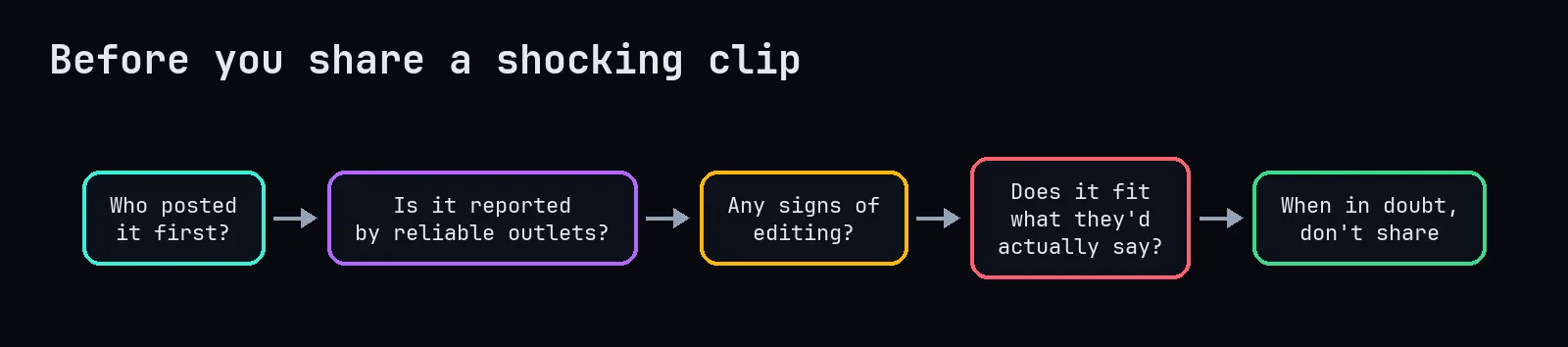
- Check the source. Who posted it first? An anonymous account created last week is not a news organisation.
- Look for corroboration. Real major news is reported by multiple reliable outlets quickly.
- Be most suspicious of content that perfectly confirms what you already believe or makes you furious. That's exactly what manipulators aim for.
- Look for signs, but don't rely on them: odd lip-sync, unnatural pauses in audio, inconsistent lighting. Fakes are improving, so absence of glitches proves nothing.
- Pause before sharing. The most effective defence is slowing down.
A note on my own field
People who build AI systems have a responsibility here: safeguards against impersonation, provenance features, refusing clearly deceptive uses, and honesty about limits. "The tool is neutral" isn't a sufficient answer when the tool makes deception cheap at scale.
The bottleneck
Technology made producing convincing media nearly free. What's now scarce is trust: in sources, in institutions, in our own judgement. Rebuilding it will take better tools, better rules and better habits. The habits part, at least, starts with us and a few seconds of patience before pressing "share."