Compound Interest: The Boring Get-Rich-Slow Scheme That Actually Works
Every get-rich-quick scheme has a guru, a countdown timer and a Lamborghini. Compound interest has none of those. It just sits there, quietly turning ordinary people into comfortable ones over a few decades. It's the most boring scheme in the world. It's also the only one with a long track record.
How it works
You invest money and it earns a return. Next year, you earn a return on your original money and on last year's return. Then on that. Growth on growth on growth. Slow at first, then surprisingly fast.
def future_value(monthly: float, annual_rate: float, years: int) -> float:
    r = annual_rate / 12
    n = years * 12
    return monthly * ((1 + r) ** n - 1) / r

print(round(future_value(200, 0.06, 40)))   # ~398,000
print(round(future_value(200, 0.06, 30)))   # ~201,000
The most important variable is time
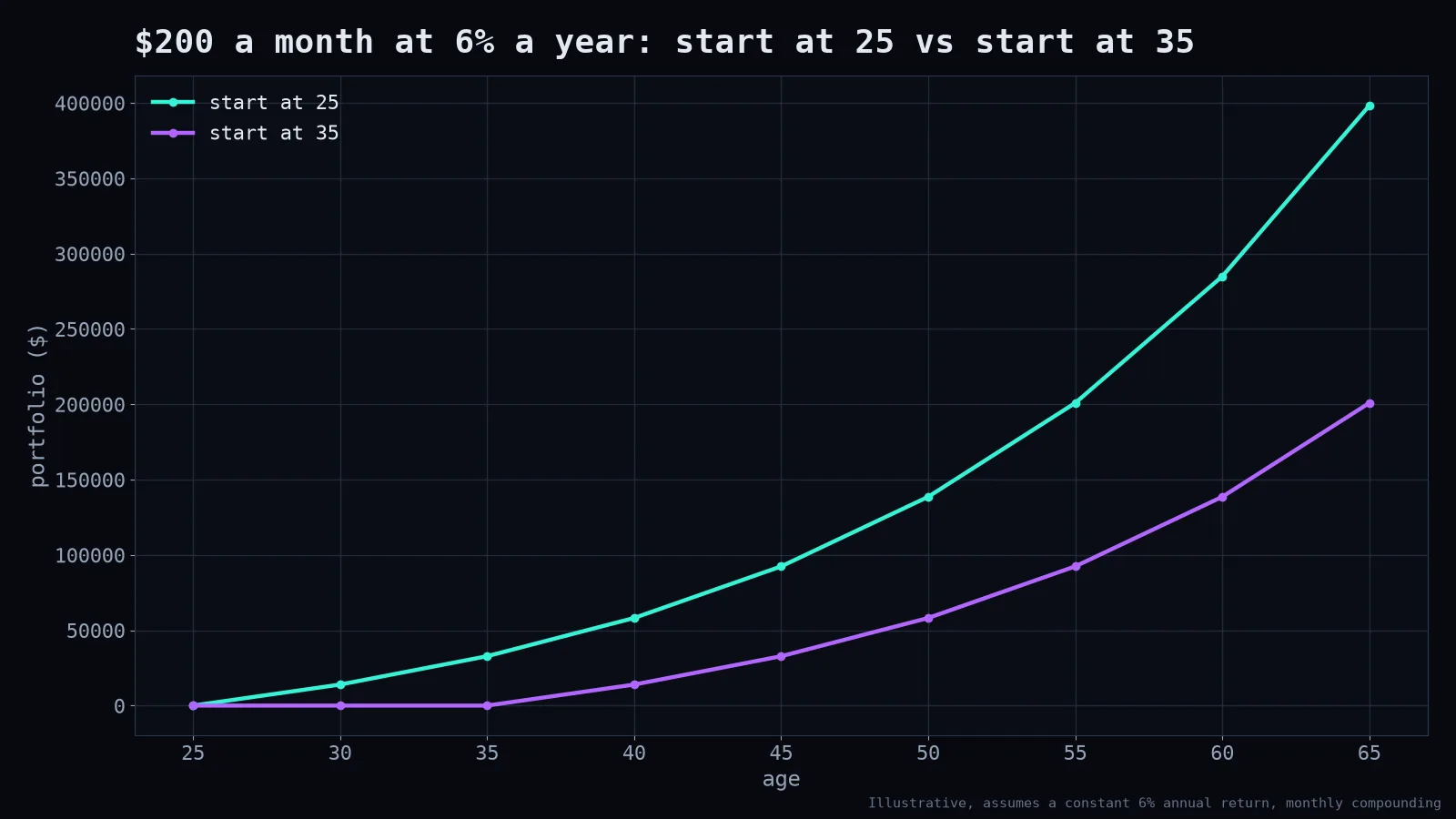
Investing $200 a month at an average 6% from age 25 to 65 gives roughly $398,000. Starting at 35 gives roughly $201,000. You only contributed $24,000 more by starting earlier, but you end up with almost twice as much, because those early dollars had extra decades to compound.
This is why "I'll start investing when I earn more" is so expensive. The best time to start was years ago. The second best time is this month, with whatever small amount you can.
Why it's boring (and why that's good)
- Nothing exciting happens most years. Your account goes up a bit, sometimes down a bit.
- Markets fall sometimes, a lot. Staying invested through the falls is the hard part, emotionally.
- The magic only shows at the end. For the first decade, it feels like nothing is happening.
The boredom is a feature. Excitement usually means risk, fees or someone selling you something.
The enemies of compounding
Fees. A 2% annual fee sounds small. Over 40 years, it can eat a huge chunk of your final amount compared with a low-cost index fund charging a fraction of that.
High-interest debt. Compound interest works against you too. Credit card debt at 20% compounds faster than almost any investment grows. Paying it off is one of the best "returns" available.
Interrupting it. Selling in a panic during a crash, or cashing out to buy something shiny, resets the clock.
Inflation. Cash under the mattress loses purchasing power every year. Compounding needs to outpace inflation to build real wealth.
A boring plan
- Build an emergency fund first, so a surprise expense doesn't force you to sell investments.
- Pay off high-interest debt.
- Use tax-advantaged accounts available in your country (in Canada, TFSAs and RRSPs; elsewhere, their local equivalents).
- Invest regularly in diversified, low-cost funds.
- Increase the amount when your income rises.
- Check it occasionally. Then go live your life.
Not financial advice: returns aren't guaranteed, and your situation is your own. But the maths is real.
The punchline
Compound interest doesn't make you rich quick. It makes you rich slow, which is better, because quick usually comes with "or poor quicker" in the small print. Albert Einstein probably never called it the eighth wonder of the world, despite the quote circulating online. He'd still have liked the maths.