The Chip Wars, Explained for Normal People
Your phone, your car, your washing machine, the server running every AI chatbot, and modern weapons systems all depend on semiconductors: tiny, astonishingly complex chips made of silicon. In the last few years, they've become one of the most contested resources in the world. News outlets call it the "chip war." Here's what that actually means.
Why chips are so hard to make
A modern advanced chip contains billions of transistors, each measured in nanometres. Making them requires:
- ultra-pure materials and cleanrooms far cleaner than hospital operating theatres
- extremely specialised machines: the most advanced lithography machines, which use extreme ultraviolet light to print patterns, are made by essentially one company in the world
- hundreds of process steps over weeks or months
- huge investment: a leading-edge factory ("fab") can cost tens of billions of dollars and take years to build
Why it's concentrated
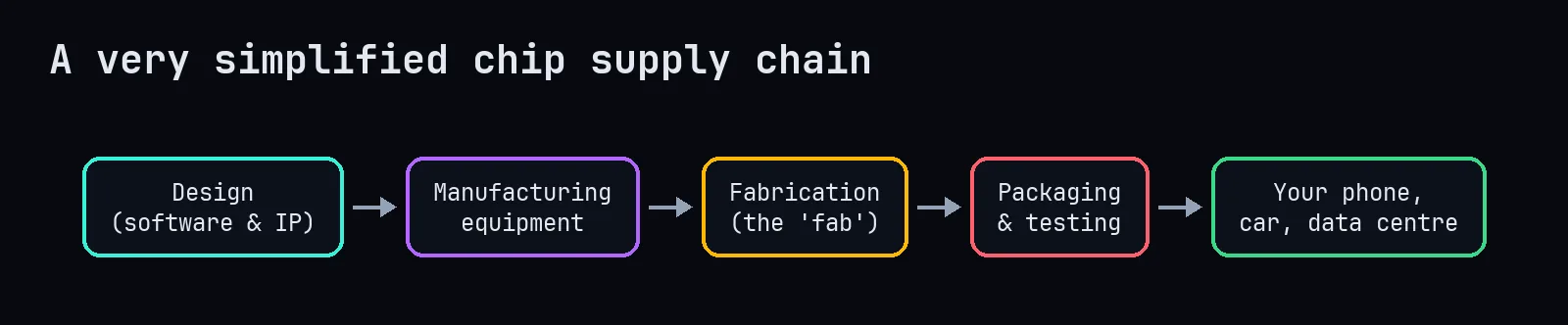
The supply chain is global but highly concentrated. Design is strong in the United States; key equipment comes from a handful of countries including the Netherlands, Japan and the US; the most advanced manufacturing is concentrated in a few places in East Asia, particularly Taiwan and South Korea; a lot of assembly and testing happens across Asia. Each part depends on the others.
That works beautifully in peaceful times. It also means a disruption in one place, whether an earthquake, a pandemic or a political crisis, can ripple through the global economy. The car industry learned this painfully during the chip shortages of the pandemic years, when factories paused for lack of inexpensive chips.
Why AI raised the stakes
Training and running large AI models requires specialised processors in enormous quantities. Advanced AI chips became strategically important, linked to economic competitiveness and military capability. As a result:
- Governments introduced export controls restricting the sale of the most advanced chips and chipmaking equipment to certain countries.
- Countries launched large subsidy programmes to build domestic manufacturing.
- Companies race to secure supply, and AI chips became one of the most valuable products in the world.
What it means for normal people
- Prices and availability of electronics can be affected by supply disruptions.
- Jobs and investment follow new factories into the regions that build them.
- Technology access may increasingly depend on geopolitics, not just markets.
The bigger picture
For decades, globalisation optimised for efficiency: build each thing where it's cheapest and best. Chips show the trade-off: maximum efficiency can mean minimum resilience. Many governments are now willing to pay more for supply chains that are less efficient but harder to break.
The next time your laptop feels slow, spare a thought for the hundreds of process steps, dozens of countries and several of the world's most complicated machines that made it possible. It's genuinely one of humanity's most impressive achievements. It's also, now, one of its most contested.