Quantum Machine Learning: Hype, Hope and a Lot of Qubits
Every few months, a headline promises that quantum computers will "revolutionise AI." Then you read the paper, and the experiment classified a few hundred data points on a handful of qubits, which a laptop could do with scikit-learn during its lunch break.
Both things can be true: quantum machine learning (QML) is a genuinely interesting research field, and most of its practical advantages are still ahead of us. Let's separate the hope from the hype.
The 60-second quantum primer
A classical bit is 0 or 1. A qubit can be in a superposition of both, described by amplitudes. Several qubits can be entangled, meaning their states are linked in ways classical bits can't imitate efficiently. The number of amplitudes describing a system grows exponentially with the number of qubits, which is where the excitement comes from.
The catch: when you measure, you get an ordinary classical result, and you have to run the circuit many times to estimate anything. Plus, today's qubits are noisy and lose their quantum state quickly.
What QML usually looks like today
Most current approaches are hybrid:
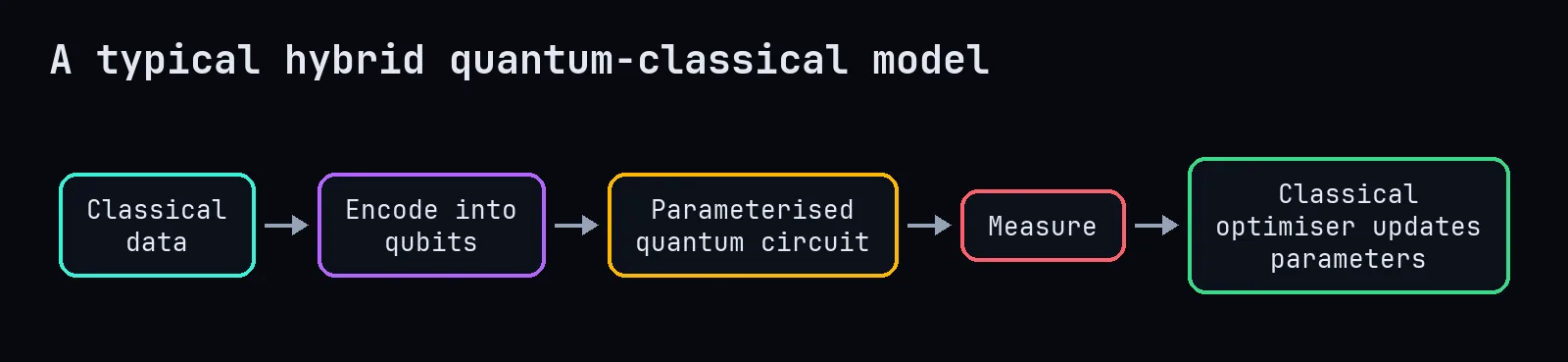
A quantum circuit with adjustable parameters (rotation angles) acts like a tiny neural network layer. A classical computer measures the output, computes a loss and adjusts the angles. Libraries like PennyLane and Qiskit make it surprisingly approachable:
import pennylane as qml
from pennylane import numpy as np

dev = qml.device("default.qubit", wires=2)

@qml.qnode(dev)
def circuit(x, weights):
    qml.RY(x[0], wires=0)
    qml.RY(x[1], wires=1)
    qml.CNOT(wires=[0, 1])
    qml.RY(weights[0], wires=0)
    qml.RY(weights[1], wires=1)
    return qml.expval(qml.PauliZ(0))
That's a simulated two-qubit model. It runs on your laptop, which is a good reminder of how small these experiments are.
The hard problems
- Noise. Current devices make errors, and full error correction needs many physical qubits per reliable logical qubit.
- Loading data. Getting a big classical dataset into quantum states can cost so much that it cancels any speed-up.
- Barren plateaus. For many circuit designs, gradients become vanishingly small as circuits grow, so training stalls.
- Fair comparisons. Claims of advantage must be compared with the best classical method, not a weak baseline.
Where the hope is real
- Problems that are naturally quantum, like simulating molecules and materials, where quantum data doesn't need loading.
- Specific kernel methods and sampling tasks with theoretical arguments for advantage.
- Hybrid algorithms that become useful as hardware improves.
How to read a QML headline
Ask: how many qubits, real hardware or simulator, compared against which classical baseline, and on what size of data? If the answers are "few, simulator, a weak baseline, tiny," it's a nice research result, not a revolution.
I spent time studying quantum computing because the ideas are beautiful, and they are. The honest position is patient curiosity: learn the fundamentals now, be sceptical of press releases, and be ready when the hardware catches up with the hype.