Prompt Engineering Is Just Asking Nicely, With Extra Steps
"Prompt engineer" was briefly the most glamorous job title on the internet. Then everyone realised that most of it is something managers have been bad at for centuries: writing a clear brief.
Here's the thing nobody says out loud. A language model is a very fast, very well-read intern who has never met you, can't see your screen and will confidently fill any gap you leave with something plausible. If your instructions are vague, you'll get vague work. Not because the model is dumb, but because you asked a question with forty possible answers.
The bad prompt
Write something about our product launch.
Something? For whom? How long? In what tone? Should it mention the price? The model will guess every one of those, and you'll spend twenty minutes "fixing" its guesses.
The useful prompt
You're writing for our company blog. Readers are small-business owners who aren't technical. Task: a 300-word announcement of our new invoicing feature. Must include: it's free on all plans, it supports CAD and USD, and it launches on 15 May. Tone: friendly and plain. No buzzwords like "revolutionary" or "seamless." Format: a headline, two short paragraphs, then three bullet points.
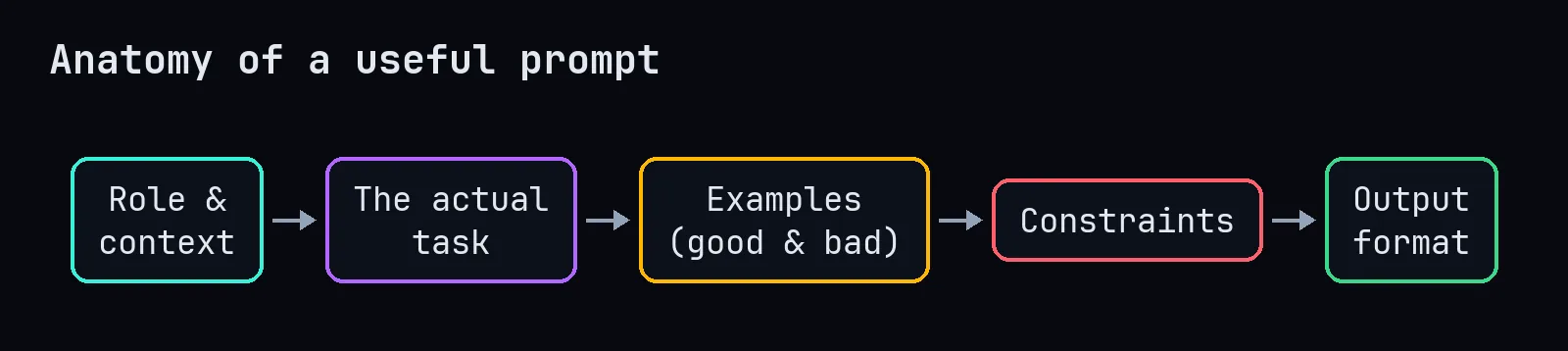
Notice there's no magic phrase in there. No "you are a world-class genius." Just context, the task, constraints and the shape of the output.
Techniques that genuinely help
Give examples. Showing one good example (and sometimes one bad one) beats a paragraph of adjectives. "Write it like this" is clearer than "make it punchy but professional."
Ask it to think before answering for maths, logic or multi-step problems. "Work through it step by step, then give the final answer on the last line" reduces silly mistakes, because the model gets space to reason instead of blurting.
Separate instructions from data. Put the document you want analysed between clear markers:
Summarise the customer email below in two sentences.
Then list any refund request as JSON.

<email>
...
</email>
Specify the format when a program will read the output. "Return only valid JSON with keys name and priority" saves you from parsing a friendly paragraph that begins with "Sure! Here's your JSON:".
Iterate. Your first prompt is a draft. When the output is wrong, ask yourself what the model couldn't have known, and add that.
Things that don't help much anymore
Threats, bribes ("I'll tip you $200") and ALL CAPS were folk remedies from the early days. Modern models respond much better to plain, specific instructions. Shouting just makes your prompt look like a ransom note.
The real skill
Prompting well is just thinking clearly about what you want before you ask. That skill also happens to make you better at emails, tickets, documentation and asking your manager for things. If AI does nothing else for us, maybe it'll finally teach the world to write a proper brief.