Error Messages, Translated Honestly
Computers communicate with us through error messages, and like any foreign language, the literal translation is not the real meaning. After many years of staring at them, here's my honest dictionary.
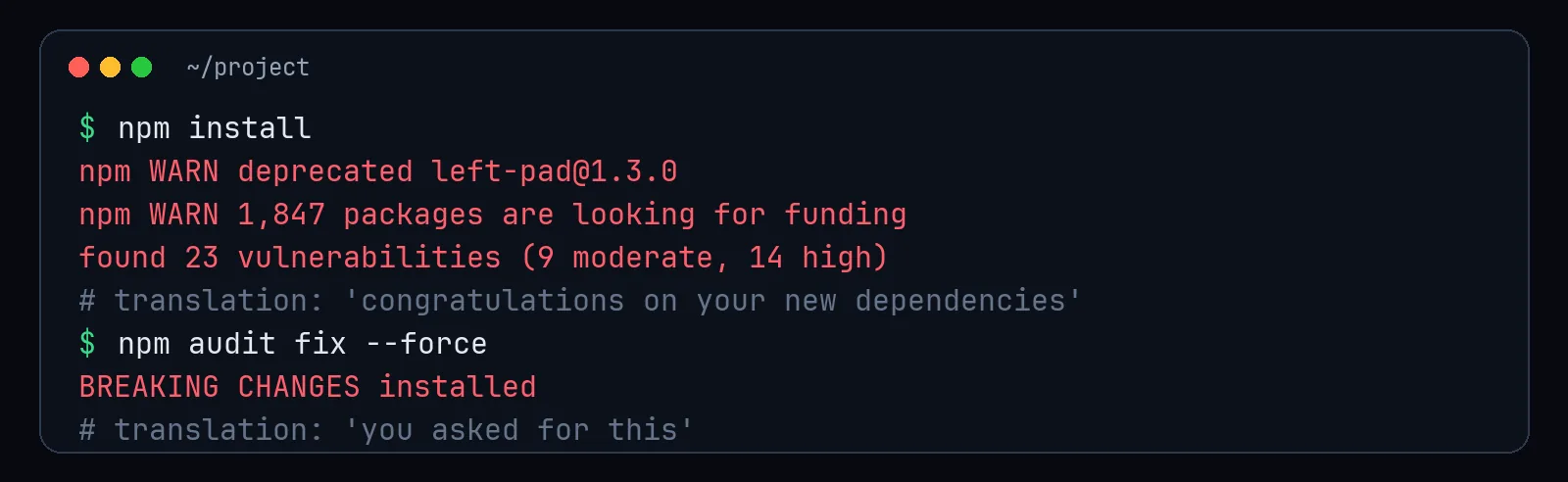
The dictionary
Segmentation fault (core dumped)
Literal: the program accessed memory it shouldn't have.
Honest: something somewhere went wrong, and I won't tell you where. Enjoy your evening.
undefined is not a function
Literal: you tried to call something that doesn't exist.
Honest: you misspelled a method name, or the data you expected hasn't arrived yet. Probably both.
It works on my machine (not technically an error message, but often the first symptom of one)
Honest: there is a difference between your machine and the server, and finding it will take the rest of the day.
Unexpected token } in JSON at position 4087
Honest: somewhere in a 9,000-character response, there's a trailing comma, and you will count characters by hand like a medieval monk.
Connection timed out
Honest: the other computer is busy, dead or ignoring you. It will not say which.
Permission denied
Honest: you need sudo. Or you definitely don't need sudo and should stop typing it.
Warning: deprecated
Honest: this works today. It will stop working on the day of your most important demo.
Error: An unknown error occurred
Honest: the developer who wrote this message also didn't know what happened. You are now colleagues in confusion.
Build succeeded with 147 warnings
Honest: the build succeeded. The warnings are a problem for future you, who is not invited to this conversation.
Out of memory
Honest: you loaded the whole dataset into a DataFrame "just to look at it."
404 Not Found
Honest: it existed yesterday. Someone renamed it.
Your session has expired
Honest: you wrote a long, thoughtful form response, and it is gone forever.
fatal: refusing to merge unrelated histories
Honest: Git is concerned about the life choices that led you here.
TypeError: Cannot read properties of null (reading 'length')
Honest: the thing you thought existed doesn't exist. Welcome to the most common bug in software.
Professional advice hidden in the jokes
- Read the whole error, including the line number and the first line of the stack trace that points to your code.
- Search the exact message in quotes. Someone has suffered before you.
- Reproduce it in the smallest possible example.
- When you write error messages for others, be the developer who says what happened and what to do next. Future colleagues will mention you fondly in their own blog posts.